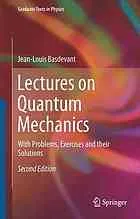
Lectures on Quantum Mechanics: With Problems, Exercises and their Solutions
Jean-Louis Basdevant
2016
View book
Book guide and evaluation
J. Bub
0 reviews
Published
pages
views
Introduction to "The Interpretation of Quantum Mechanics" Quantum mechanics stands as one of the most fascinating and complex areas in modern physics—a field that challenges not only our technical understanding of the universe but also our philosophical views of realit
Before you read
Quantum mechanics stands as one of the most fascinating and complex areas in modern physics—a field that challenges not only our technical understanding of the universe but also our philosophical views of reality. "The Interpretation of Quantum Mechanics" is a compelling exploration of these questions, providing readers with a thorough analysis of both the foundational principles of quantum mechanics and the philosophical issues it raises. This introduction aims to give you a detailed overview of the book and its impactful contributions to the worlds of science and philosophy.
"The Interpretation of Quantum Mechanics" begins by laying out the fundamental principles of quantum theory, tackling the concepts of wave-particle duality, superposition, and entanglement. The book meticulously analyzes how quantum mechanics differs from classical physics, emphasizing what makes this theory revolutionary.
A key focus of the book is the so-called "measurement problem"—an issue that puts into question the very nature of observation and reality in quantum systems. Through vivid examples and mathematical rigor, the reader is guided through landmark ideas such as Heisenberg's uncertainty principle and Schrödinger's cat thought experiment.
Each chapter deals with one or more interpretations of quantum mechanics, such as the Copenhagen interpretation, the Everettian (Many-Worlds) interpretation, hidden variable theories like Bohmian mechanics, and the more contemporary relational quantum mechanics. The book does an excellent job of presenting the pros and cons of each interpretation, allowing readers to make sense of the trade-offs inherent to these competing theories.
Importantly, the book doesn't shy away from the philosophical dilemmas raised by quantum mechanics, such as questions about determinism, locality, and the role of probability in the physical world. Regardless of whether the reader approaches quantum mechanics from a purely scientific or a philosophical perspective, this book provides a balanced and rigorous framework for thinking about its interpretation.
Ultimately, the book seeks to inspire curiosity and provoke thoughtful reflection on how quantum mechanics shapes our understanding of the universe.
"Quantum mechanics does not just challenge our understanding of the microscopic world—it compels us to rethink the nature of reality itself."
"The measurement problem is not merely a technical glitch; it is a doorway into the deepest questions about what it means to 'measure' anything at all."
"To interpret quantum mechanics is to wrestle with notions of universality, locality, and determinism as they collide with the probabilistic fabric of our observations."
Quantum mechanics has practical applications that permeate modern life, from semiconductors in electronics to quantum computing. However, its philosophical implications are equally profound, touching on the essence of how we perceive reality and interact with the natural world. This book delves into these questions with clarity and precision, offering one of the most comprehensive guides to interpreting this extraordinary branch of physics.
For students, researchers, and anyone with a keen interest in the foundations of science, "The Interpretation of Quantum Mechanics" serves as an invaluable resource. It bridges gaps between theoretical physics, experimental evidence, and philosophical inquiry, enabling readers to form their own informed perspectives. Most importantly, the book challenges its audience to question assumptions and venture into the unknown, embracing the full intellectual adventure that quantum mechanics offers.
Your question is answered in the context of this title and author. Each answer uses 2 points.
0 reviews, 4.4 average out of 5
Sign in to publish a review.
Ask a focused question and learn from the community.
Related references that continue this learning path.
Jean-Louis Basdevant

Arnold F. Nikiforov,Vladimir G. Novikov,V.B. Uvarov (auth.)