
Book guide and evaluation
The history and development of the theory of partitions
Salatino,Joan P
English
Beginner
Art
4.6 / 5
0 reviews
0
Published
87
pages
449
views
Introduction to 'The History and Development of the Theory of Partitions' Welcome to a journey through the rich tapestry of mathematical thought that is woven into the theory of partitions. This book delves deeply into the fascinating history and sophisticated development
Before you read
What will you get from this book?
Introduction to 'The History and Development of the Theory of Partitions'
Welcome to a journey through the rich tapestry of mathematical thought that is woven into the theory of partitions. This book delves deeply into the fascinating history and sophisticated development of partition theory, revealing the subtle intricacies and profound insights that it offers to both historical and contemporary mathematical landscapes.
Detailed Summary of the Book
The theory of partitions is a classical branch of number theory, primarily concerned with expressing numbers as sums of other numbers. Its development has been shaped by a multitude of brilliant minds over the centuries, each contributing their own unique perspectives and findings. In this book, we explore the progression of partition theory from its earliest inklings in the works of Euler, who laid its foundational concepts, to its significant expansions by figures like Ramanujan and Littlewood.
Each chapter guides you through historical milestones, examining key theorems and pivotal discoveries. From Euler's pentagonal number theorem to the breakthroughs of the 20th century, readers will appreciate how the theory of partitions has grown, adapting to new mathematical challenges and becoming a vital tool in a variety of fields such as combinatorics, mathematical analysis, and even physics. This book doesn't merely recount past achievements but also highlights ongoing research and potential future directions.
Key Takeaways
- Understand the fundamental principles of partition theory and its applications across various scientific fields.
- Gain insights into the historical context and evolution of mathematical ideas over centuries.
- Recognize the contributions of major mathematicians and how their work has shaped contemporary partition theory.
- Identify the connection between partition theory and modern mathematical challenges.
Famous Quotes from the Book
"The beauty of partition theory lies not just in its ability to solve intriguing puzzles, but in its revelation of the interconnectedness of mathematical truths."
"Just as a single partition can be expressed in myriad forms, so too can the ideas and innovations in math unfold into a tapestry of complexity and wonder."
Why This Book Matters
This book holds significance for both mathematical enthusiasts and scholars due to its comprehensive approach to a niche yet extremely rich field. By following the historical developments and acknowledging the giants on whose shoulders modern mathematics stands, it offers readers a broad perspective on how a seemingly simple concept can evolve into a fundamental part of mathematical theory.
Furthermore, the book emphasizes the relevance of partition theory in solving real-world problems and advancing theoretical research. In doing so, it bridges the gap between past mathematical milestones and future innovations, making it an essential read for anyone interested in the progression of mathematical thought.
Through detailed exposition and insightful analysis, 'The History and Development of the Theory of Partitions' invites readers to explore the elegance of mathematical partitioning while appreciating the historical narratives and future implications inherent in its study.
Ask this book
Your question is answered in the context of this title and author. Each answer uses 2 points.
Sign in to ask the book assistant.
Reader reviews
0 reviews, 4.6 average out of 5
No reviews yet
If you have read this book, help the next reader with your experience.
Write a review
Sign in to publish a review.
Reader questions and answers
Ask a focused question and learn from the community.
Sign in to ask or answer a question.
No questions yet
Be the first to ask a clear, useful question.
What to read next
Related references that continue this learning path.
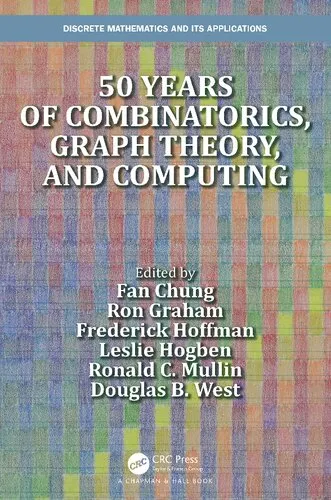
50 years of Combinatorics, Graph Theory, and Computing (Discrete Mathematics and Its Applications)
Fan Chung (editor),Ron Graham (editor),Frederick Hoffman (editor),Ronald C. Mullin (editor),Leslie Hogben (editor),Douglas B. West (editor)
2019
View book
New perspectives in algebraic combinatorics
Louis J. Billera,Anders Björner,Curtis Greene,Rodica E. Simion,Richard P. Stanley
1999
View book