The Essential Cosmic Perspective, 6th Edition
Jeffrey O. Bennett,Megan Donahue,Nicholas O Schneider,Mark Voit
2010
View book
Book guide and evaluation
André Balogh,Louis J. Lanzerotti,S.T. Suess
0 reviews
Published
pages
views
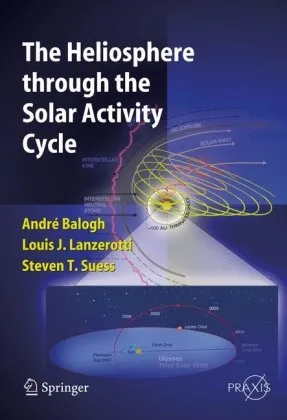
Introduction to "The Heliosphere through the Solar Activity Cycle" "The Heliosphere through the Solar Activity Cycle," part of the renowned Springer Praxis Books series in Astronomy and Planetary Sciences, explores the dynamic and intriguing nature of the heli
Before you read
"The Heliosphere through the Solar Activity Cycle," part of the renowned Springer Praxis Books series in Astronomy and Planetary Sciences, explores the dynamic and intriguing nature of the heliosphere, the vast bubble of charged particles and magnetic fields created by the Sun. Written by experts André Balogh, Louis J. Lanzerotti, and S.T. Suess, this comprehensive book delves into how the heliosphere evolves over the 11-year solar cycle, providing critical insights into the Sun's activity, its impacts on the solar system, and its interactions with the interstellar medium.
The authors leverage decades of scientific research and space mission data to analyze one of nature's most complex systems, making the book an essential resource for astrophysicists, planetary scientists, space weather researchers, and engineers in the space sector. While sophisticated in content, the text is meticulously structured to cater to a wide audience, from seasoned researchers to advanced students eager to understand the Sun's influence on the heliosphere.
The book meticulously analyzes the intricate connections between solar processes and heliospheric phenomena as the solar activity cycle progresses through its minimum and maximum phases. The authors provide a holistic perspective on how the solar wind, magnetic fields, cosmic rays, and interplanetary shocks evolve in response to changes in solar activity. The text begins with an overview of the solar activity cycle and its implications for heliophysics, followed by comprehensive chapters on dynamic structures in the heliosphere such as coronal mass ejections (CMEs), high-speed solar wind streams, and heliospheric current sheets.
Through a combination of theoretical frameworks and observational data, the book evaluates the spatial and temporal variability of the heliosphere. Key topics include the interaction of the heliosphere with the interstellar medium, the heliospheric boundary regions, and the role of cosmic rays in defining the energetic properties of the heliosphere. Beyond its descriptive narrative, the authors delve into the practical importance of understanding heliospheric physics, from its implications for spacecraft design to its relevance for understanding space climate and weather.
Furthermore, the text highlights the contributions of major space missions, such as Ulysses, Voyager, and the Parker Solar Probe, to advancing our understanding of heliospheric science. It links empirical data with theoretical models, offering a comprehensive look at the heliosphere as a dynamic, evolving system influenced by the Sun and the galactic environment.
"The heliosphere not only serves as a protective shield for the planetary bodies within our solar system but also as an intricate, dynamic laboratory of astrophysical phenomena."
"Observing the Sun’s activity cycle reveals the profound influence of our star on shaping the space environment through which the solar system journey unfolds."
"The heliosphere is where the local astrophysical environment and interstellar medium first meet—it defines the boundary and connection between solar and galactic domains."
"The Heliosphere through the Solar Activity Cycle" holds a unique place in the study of heliophysics because it provides a detailed examination of the heliosphere as a dynamic, interconnected system. The heliosphere serves as the gateway between the solar system and the interstellar medium, playing a key role in determining the conditions of space that impact not only planetary atmospheres but also technological systems on Earth.
As humankind becomes increasingly dependent on space-based systems for communication, navigation, and research, understanding heliospheric phenomena has never been more crucial. This book bridges the gap between theoretical research and practical applications, emphasizing the importance of heliophysical studies in mitigating risks related to space weather and advancing planetary exploration. By focusing on the solar activity cycle, the authors underscore the temporal variability of the heliosphere—the very property that makes it both fascinating and scientifically vital.
In an era of groundbreaking space missions and increased reliance on space technologies, "The Heliosphere through the Solar Activity Cycle" is a must-read for anyone seeking to understand the Sun’s profound influence on the solar system and beyond.
Your question is answered in the context of this title and author. Each answer uses 2 points.
0 reviews, 4.5 average out of 5
Sign in to publish a review.
Ask a focused question and learn from the community.
Related references that continue this learning path.
Jeffrey O. Bennett,Megan Donahue,Nicholas O Schneider,Mark Voit
Jeffrey O. Bennett,Megan O. Donahue,Nicholas Schneider,Mark Voit
Consolmagno, Guy;Davis, Dan Michael