
Book guide and evaluation
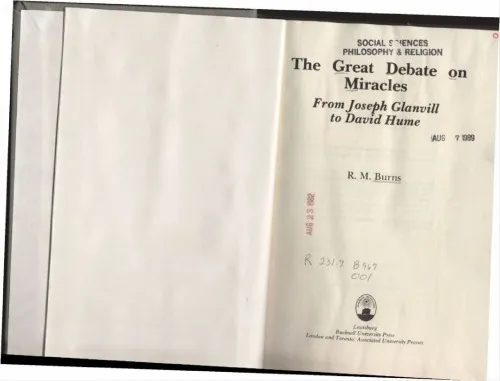
The Great Debate on Miracles: From Joseph Glanvill to David Hume
Robert M. Burns
English
Beginner
Art
4.5 / 5
0 reviews
1981
Published
152
pages
257
views
Introduction to "The Great Debate on Miracles: From Joseph Glanvill to David Hume" Miracles—phenomena that seemingly defy the natural order—have been a source of fascination and controversy for centuries. "The Great Debate on Miracles: From Joseph Glanvill to David Hume" e
Before you read
What will you get from this book?
Introduction to "The Great Debate on Miracles: From Joseph Glanvill to David Hume"
Miracles—phenomena that seemingly defy the natural order—have been a source of fascination and controversy for centuries. "The Great Debate on Miracles: From Joseph Glanvill to David Hume" explores one of the most pivotal discussions in Western intellectual history, delving into the central arguments surrounding miracles and their implications for knowledge, religion, and philosophy. This book traces the evolution of the debate through the works of key thinkers from the 17th and 18th centuries, with a particular focus on the contributions of Joseph Glanvill and David Hume.
By examining this critical intellectual history, the work provides readers with a deeper understanding of the philosophical and theological tensions that have shaped the discourse on miracles. Whether you are a historian, philosopher, theologian, or simply curious about how humanity grapples with the idea of the supernatural, this book offers invaluable insights into the intricate arguments that continue to influence contemporary thought.
Detailed Summary of the Book
Tracing the progression of ideas regarding miracles requires a methodical exploration, which this book undertakes comprehensively.
"The Great Debate on Miracles" begins with an analysis of Joseph Glanvill's writings. Glanvill, a 17th-century philosopher and clergyman, defended the validity of supernatural occurrences as evidence of divine intervention. His theological perspective viewed miracles as a cornerstone of religious belief and a testament to the existence of a supreme being. The book extensively discusses Glanvill's reasoning, emphasizing the interplay of faith and empirical observation in his arguments.
From Glanvill, the work transitions to other notable contributors to the debate, presenting a chronological narrative that contextualizes the intellectual climate of the time. It examines how the scientific revolution, rising skepticism, and the Enlightenment collectively impacted the discussion and contributed new dimensions to the debate. Each thinker is presented not just in isolation but as part of an ongoing dialogue in Western thought.
Central to the book is David Hume's influential essay "Of Miracles," a seminal text in the philosophy of religion. Hume's arguments are dissected in detail, with special attention given to his critique of testimonial evidence—the cornerstone of many miracle claims. By weighing human fallibility, the improbability of miracles, and the reliability of witnesses, Hume set the stage for modern skepticism.
The book culminates with a comparative analysis of Glanvill's foundational support for miracles and Hume's systematic deconstruction, highlighting the intellectual tensions between faith and reason. Overall, "The Great Debate on Miracles" paints a vivid picture of a centuries-long conversation that has profoundly influenced Western thinking.
Key Takeaways
- The debate on miracles serves as a microcosm of broader philosophical conflicts, including reason versus faith and skepticism versus credulity.
- Joseph Glanvill’s writings represent an early example of the interplay between empirical observation and theological belief.
- David Hume’s arguments against miracles became a landmark in the philosophy of religion, shaping modern skepticism.
- Understanding this debate offers a lens into how philosophical, religious, and scientific ideas intersect and evolve over time.
- The ideas discussed remain relevant, influencing contemporary discourse on the nature of evidence and belief.
Famous Quotes from the Book
"To deny the possibility of miracles is to confine reality to the boundaries of human understanding."
"It is not faith that fears reason, but dogma that trembles at the mere touch of skepticism."
"David Hume taught us not only to question miracles but also to question the very foundation of why we believe anything at all."
Why This Book Matters
The enduring relevance of the debate on miracles cannot be overstated. At its core, this book addresses fundamental questions about belief, evidence, and the human understanding of the universe.
By bridging theology, philosophy, and the history of ideas, "The Great Debate on Miracles" provides a rich, interdisciplinary perspective on one of humanity's most profound intellectual challenges. The arguments presented in this book offer timeless insights into the fragile interplay between faith and reason, making it a valuable resource for anyone exploring religion, philosophy, or the history of ideas.
Furthermore, the book shines a spotlight on pivotal historical moments such as the Enlightenment and the scientific revolution. As these cultural shifts transformed how societies approached truth and evidence, the debate on miracles became a battleground where old and new worldviews clashed. For modern readers, immersing oneself in this debate is not only enlightening but also a reminder that the questions raised here continue to shape human thought in significant ways.
Whether you are a scholar, a student, or a casual inquirer, "The Great Debate on Miracles" invites you to join a conversation that has fascinated and perplexed humanity for centuries.
Ask this book
Your question is answered in the context of this title and author. Each answer uses 2 points.
Sign in to ask the book assistant.
Reader reviews
0 reviews, 4.5 average out of 5
No reviews yet
If you have read this book, help the next reader with your experience.
Write a review
Sign in to publish a review.
Reader questions and answers
Ask a focused question and learn from the community.
Sign in to ask or answer a question.
No questions yet
Be the first to ask a clear, useful question.
What to read next
Related references that continue this learning path.

Modern Computer Vision with PyTorch: A Practical Roadmap From Deep Learning Fundamentals to Advanced Applications and Generative AI, 2nd Edition
V Kishore Ayyadevara,Yeshwanth Reddy
2023
View book