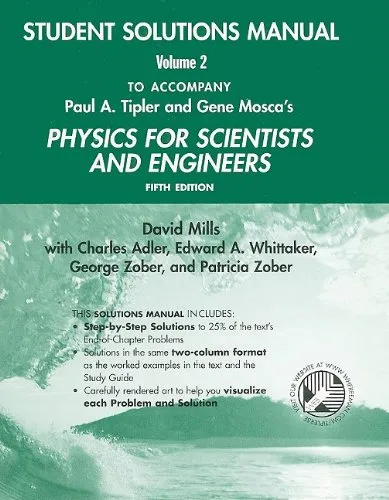
Physics for Scientists and Engineers Student Solutions Manual, Volume 2 (v. 2 & 3)
Gene Mosca,Todd Ruskell
2003
View book
Book guide and evaluation
Theodore Frankel
0 reviews
Published
pages
views
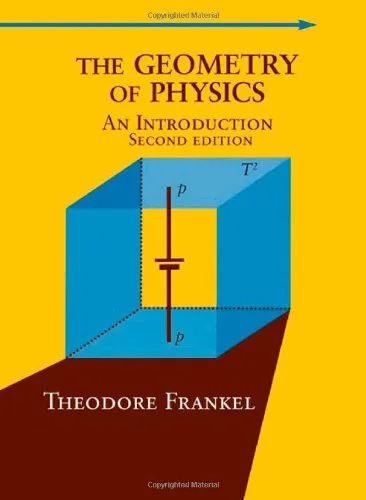
Introduction to "The Geometry of Physics: An Introduction" The field of mathematical physics is vast, intricate, and deeply fascinating. In "The Geometry of Physics: An Introduction," I aimed to create a resource that connects the pure elegance of modern differential geome
Before you read
The field of mathematical physics is vast, intricate, and deeply fascinating. In "The Geometry of Physics: An Introduction," I aimed to create a resource that connects the pure elegance of modern differential geometry with its profound applications in classical and quantum physics. This book is designed for readers who aspire to explore the interplay between mathematics and physics, providing a robust and accessible framework for understanding the geometry that underpins some of the most revolutionary scientific concepts.
The book serves both as an academic textbook and a reference for researchers, bridging gaps between mathematics, theoretical physics, and applications in contemporary science. It brings together ideas from a variety of topics, including differential geometry, topology, mechanics, general relativity, gauge theory, and quantum field theory. Without delving into overly complex formalism, "The Geometry of Physics" strives to balance intuitive explanation with technical accuracy, making it an excellent resource for mathematicians and physicists alike.
The book is a comprehensive introduction to the geometric principles underpinning physics. Starting with fundamental notions of differential geometry, the work progresses toward more complex structures vital in physics, such as fiber bundles and symplectic geometry.
The first chapters thoroughly cover the mathematical language necessary to navigate the subject, including manifolds, tensors, and differential forms. These tools are essential for understanding concepts like curvature, connections, and the geometry of spacetime. The intuitive development of these ideas prepares the reader for their application in classical mechanics, electromagnetism, and general relativity.
As the book delves deeper, it explores sophisticated subjects such as Lie groups, Lie algebras, and gauge theories, which are cornerstones of modern theoretical physics. Particular emphasis is placed on the geometry of principal and vector bundles, where gauge invariance and symmetry groups naturally arise. Later sections investigate symplectic geometry, forming the mathematical basis for classical mechanics and Hamiltonian dynamics.
Finally, the theoretical framework extends to field theories, including quantum field theory and the Standard Model of particle physics. This progression illustrates how geometry remains central to every stage of mathematical physics. By the end of the text, readers will acquire tools to analyze physical theories geometrically while linking abstract mathematical concepts to tangible physical phenomena.
This book equips readers with a well-rounded understanding of how geometry shapes the mathematical framework of physics, connecting abstract ideas to physical reality.
"Geometry is not merely a tool for physics—it is the very language through which the natural laws are articulated."
"Curvature and connection are not just mathematical constructs; they embody the dynamic interplay of spacetime, matter, and energy."
"The elegance of gauge theory lies in its ability to transform symmetry into a guiding principle for the forces that govern reality."
"The Geometry of Physics: An Introduction" is an indispensable resource for anyone aiming to deeply understand the geometric foundations of modern physics. Geometric reasoning has been instrumental in constructing some of the most successful theories in science, from Einstein's general relativity to Yang-Mills gauge theory. This work synthesizes these ideas into a cohesive and rigorous framework.
The book appeals to a wide audience—graduate students seeking an introduction to geometric physics, researchers aiming to connect mathematical rigor with physical intuition, and educators requiring a single resource that bridges physics and geometry. By combining clarity with depth, it ensures that readers at any stage of their journey can grasp the material and grow their understanding of geometry as both a mathematical science and a tool in theoretical physics.
In a field as interdisciplinary as mathematical physics, having a resource that facilitates seamless understanding across domains is both necessary and impactful. This book fulfills that role, contributing meaningfully to the education and advancement of the next generation of mathematicians and physicists. Its importance lies in its ability to demystify complex concepts, foster interdisciplinary learning, and inspire curiosity about the fundamental structures of the universe.
Your question is answered in the context of this title and author. Each answer uses 2 points.
0 reviews, 4.7 average out of 5
Sign in to publish a review.
Ask a focused question and learn from the community.
Related references that continue this learning path.
Gene Mosca,Todd Ruskell