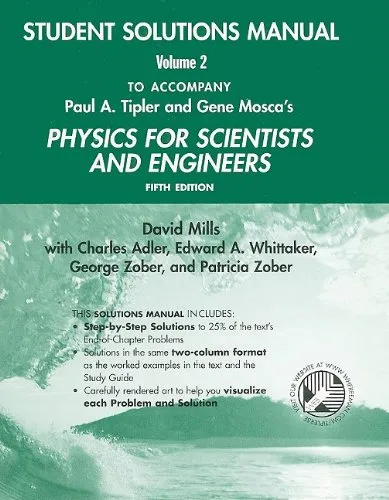
Physics for Scientists and Engineers Student Solutions Manual, Volume 2 (v. 2 & 3)
Gene Mosca,Todd Ruskell
2003
View book
Book guide and evaluation
Theodore Frankel
0 reviews
Published
pages
views
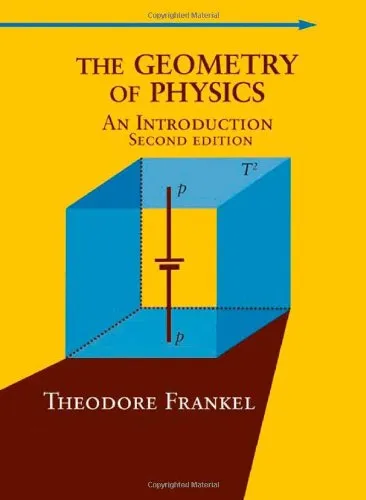
Introduction to 'The Geometry of Physics: An Introduction, Second Edition' Discover a groundbreaking exploration of the intimate relationship between physics and geometry in this comprehensive guide. Authored by Theodore Frankel, 'The Geometry of Physics: An Introduction, Seco
Before you read
Discover a groundbreaking exploration of the intimate relationship between physics and geometry in this comprehensive guide. Authored by Theodore Frankel, 'The Geometry of Physics: An Introduction, Second Edition' bridges the gap between the complex theoretical underpinnings of modern physics and the elegant mathematical structures that describe them. With clarity and depth, this book introduces readers to the geometric concepts that serve as a foundation for a wide range of physical theories.
This second edition, revised and expanded, builds upon the success of its predecessor to present an even more enriched experience for both students and professionals. The book covers essential topics such as differential geometry, vector bundles, Lie groups, and Riemannian geometry, making them accessible to physicists unfamiliar with advanced mathematical techniques. Alongside these powerful tools, applications to physics feature prominently, particularly in areas such as general relativity, gauge theory, and fluid dynamics.
The narrative integrates mathematical rigor with physical intuition, ensuring that abstract concepts are supplemented by insightful examples and physical applications. For instance, the work examines the role of curvature in Einstein's theory of general relativity while also delving into the mathematical underpinnings of fiber bundles and connections in gauge theory. From classical mechanics to modern quantum field theory, the geometric perspective allows for a cohesive understanding of these seemingly disparate topics.
With new exercises, additional sections, and updated material reflecting recent developments, this edition is both a timeless resource and a modern reference. It is designed to cater to a wide audience, including physicists, mathematicians, and engineers aiming to deepen their knowledge of this unique interplay between geometry and physics.
"Geometry has long provided physics with a powerful vocabulary; more than that, it offers a profound framework within which laws of nature can be expressed and understood."
"To study physics through the lens of geometry is to embark on a journey that captures the elegance of nature's language."
"Symmetry is not merely a mathematical curiosity but a cornerstone upon which the universe builds its laws."
In the realm of modern physics and mathematics, understanding the geometry underlying physical theories has become indispensable. This book acts as a bridge, bringing advanced mathematical methods to physicists while simultaneously offering mathematicians a tangible connection to physical theories. It stands out as a unique contribution due to its careful balance of theoretical depth and physical application.
The study of topics like curvature, symmetry, and connections in gauge fields is not merely theoretical but forms the backbone of contemporary scientific advancements. Whether exploring black hole thermodynamics, quantum field theory, or the unification of forces, these geometric concepts are central. By emphasizing these interconnections, 'The Geometry of Physics: An Introduction, Second Edition' empowers learners to grasp the underlying unity within the complexity of physical systems.
In addition, the book serves as a pedagogical masterpiece, offering intuitive explanations that demystify even the most intricate concepts. It stands as a vital resource for students, educators, and researchers who seek a deeper appreciation and understanding of the universe through the marriage of geometry and physics. Its value lies not only in the knowledge it imparts but in the foundational mindset it fosters for approaching scientific challenges.
Your question is answered in the context of this title and author. Each answer uses 2 points.
0 reviews, 4.6 average out of 5
Sign in to publish a review.
Ask a focused question and learn from the community.
Related references that continue this learning path.
Gene Mosca,Todd Ruskell