
Book guide and evaluation
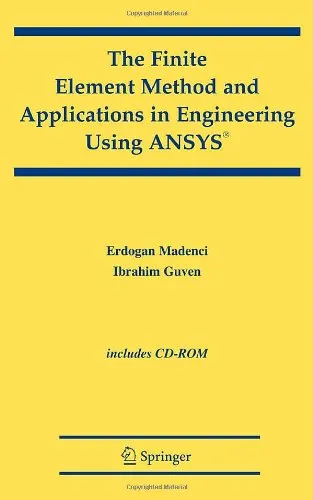
The Finite Element Method and Applications in Engineering Using ANSYS
Erdogan Madenci,Ibrahim Guven
English
Beginner
Engineering
4.8 / 5
0 reviews
2006
Published
696
pages
292
views
Introduction to "The Finite Element Method and Applications in Engineering Using ANSYS" "The Finite Element Method and Applications in Engineering Using ANSYS" is a comprehensive guide designed to meet the needs of both engineering students and professionals who wish to un
Before you read
What will you get from this book?
Introduction to "The Finite Element Method and Applications in Engineering Using ANSYS"
"The Finite Element Method and Applications in Engineering Using ANSYS" is a comprehensive guide designed to meet the needs of both engineering students and professionals who wish to understand and apply the finite element method (FEM) for solving complex engineering problems. Written by Erdogan Madenci and Ibrahim Guven, the book bridges the gap between theoretical concepts and their real-world implementation using the industry-standard ANSYS software.
This book provides an intuitive introduction to FEM, focusing on the practical aspects of computational modeling while equally emphasizing the underlying physics and mathematics. With hands-on exercises and examples drawn from structural, thermal, and fluid mechanics, this text ensures that readers develop a deep understanding of the finite element analysis process.
Detailed Summary of the Book
Bridging Theory and Practice
The book begins by introducing foundational concepts of FEM, including the representation of geometry, meshing, and the formulation and assembly of stiffness matrices. These topics are presented in a clear and logical progression, ensuring that readers grasp the basics before engaging in more advanced applications. Each chapter builds upon the last, forming a seamless narrative for learning.
A significant portion of the book is devoted to practical applications of FEM in engineering disciplines. By leveraging ANSYS, a powerful and widely used finite element analysis tool, the authors guide readers through creating detailed models of complex engineering systems. Topics such as static analysis, dynamic analysis, heat transfer, and elastic buckling are explored through step-by-step tutorials, paired with hands-on exercises. These techniques teach readers how to simulate real-world engineering problems efficiently.
To reinforce the concepts, the book includes numerous examples, detailed explanations, and graphs. Additionally, readers are provided with tips for enhancing computational efficiency and improving the accuracy of their models. Emphasis is placed on understanding how to interpret results and make engineering judgments that align with physical intuition. This makes the book not just a guide for software users, but a resource for solving practical engineering challenges.
Key Takeaways
What Readers Will Learn
- A thorough understanding of the finite element method (FEM) and its mathematical basis.
- Step-by-step guidance for using ANSYS software to model and solve engineering problems.
- Techniques for creating accurate meshes and understanding convergence criteria in simulations.
- How to apply FEM techniques to real-world domains, including structural mechanics, fluid flow, and heat transfer.
- Insights into interpreting results and validating numerical simulations against physical results.
- Advanced topics such as nonlinear analysis, dynamic analysis, and optimization using FEM tools.
Famous Quotes from the Book
"The finite element method is more than just a numerical technique—it is the universal language of engineering analysis."
"Understanding the mathematics behind FEM is not merely theoretical, but essential for harnessing its full potential in computational engineering."
"The power of ANSYS lies not only in its advanced capabilities but also in the user’s ability to approach problems with clarity, precision, and engineering insight."
Why This Book Matters
An Indispensable Resource for Engineers
Finite element analysis has become a cornerstone of modern engineering design and analysis. From designing skyscrapers to optimizing aerodynamics in automotive and aerospace engineering, FEM is indispensable for solving complex problems that are difficult or impossible to tackle analytically. This book serves as a bridge between theoretical knowledge and practical mastery, equipping engineers and researchers to excel in their fields.
The authors, Erdogan Madenci and Ibrahim Guven, combine decades of experience in both academia and industry. Their expertise ensures that this book is not only rigorous in its theoretical foundation but also immensely practical for real-world applications. By integrating ANSYS tutorials with foundational concepts, the book provides an unparalleled resource for learning FEM in a hands-on, application-oriented manner.
Whether you are a student aiming to build your engineering analysis foundation or a professional expanding your expertise, this book empowers you with the skills and confidence to tackle today's engineering challenges. Its clear explanations, practical examples, and focus on bridging theory with practice make it a must-have for anyone involved in finite element modeling and computational engineering.
Ask this book
Your question is answered in the context of this title and author. Each answer uses 2 points.
Sign in to ask the book assistant.
Reader reviews
0 reviews, 4.8 average out of 5
No reviews yet
If you have read this book, help the next reader with your experience.
Write a review
Sign in to publish a review.
Reader questions and answers
Ask a focused question and learn from the community.
Sign in to ask or answer a question.
No questions yet
Be the first to ask a clear, useful question.
What to read next
Related references that continue this learning path.


Modern Computer Vision with PyTorch: A Practical Roadmap From Deep Learning Fundamentals to Advanced Applications and Generative AI, 2nd Edition
V Kishore Ayyadevara,Yeshwanth Reddy
2023
View book