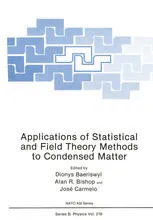
Applications of Statistical and Field Theory Methods to Condensed Matter
A. J. Leggett (auth.),Dionys Baeriswyl,Alan R. Bishop,José Carmelo (eds.)
1990
View book
Book guide and evaluation
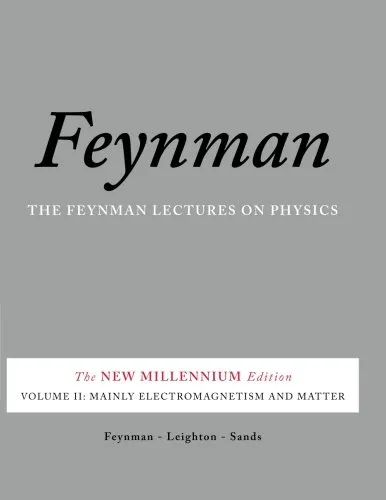
Richard P. Feynman,Robert B. Leighton,Matthew Sands
0 reviews
Published
pages
views
Introduction to The Feynman Lectures on Physics, Vol. II The Feynman Lectures on Physics, Vol. II: The New Millennium Edition: Mainly Electromagnetism and Matter is an insightful exploration into the realm of physics, brought to life through the captivating lectu
Before you read
The Feynman Lectures on Physics, Vol. II: The New Millennium Edition: Mainly Electromagnetism and Matter is an insightful exploration into the realm of physics, brought to life through the captivating lectures of Richard P. Feynman. This volume, a part of the landmark series that has enlightened thousands of students and enthusiasts, delves into the intricacies of electromagnetism and the properties of matter, presenting challenging concepts through the lens of Feynman's unique insight and engaging teaching style.
The second volume of The Feynman Lectures on Physics delves primarily into electromagnetism, the interaction of electricity and magnetism, and how these fundamental forces underpin much of the physical world. Richard P. Feynman, alongside Robert B. Leighton and Matthew Sands, skillfully navigates through topics such as electrostatics, electric currents, magnetism, electromagnetic fields, and electromagnetic waves.
The book starts by establishing a solid foundation in electrostatics, examining the behavior of charges at rest. It then transitions into dynamic phenomena, exploring how electric currents induce magnetic fields and the principles governing electromagnetism. Through this narrative, Feynman employs a multitude of thought experiments and real-world examples to demystify complex ideas, reinforcing the importance of Maxwell's equations as the cornerstone of electromagnetism.
This volume also touches upon the quantum mechanics of matter, providing a comprehensive overview of how electromagnetic forces influence material properties and interactions at the atomic level. Discussions about dielectrics, magnetic materials, and the role of fields in matter bridge the conceptual gap between classical electromagnetism and quantum physics.
"The real glory of science is that we can find a way of thinking such that the law is evident."
"We must leave the possibility that there may be laws beyond the known laws. However, the known laws will probably suffice to uncover new ideas, and this balance is very delicate and important."
The Feynman Lectures on Physics, Vol. II, matters not just as a textbook, but as a testament to the beauty and coherence of nature through the framework of electromagnetism and matter. Richard Feynman's ability to illuminate complex principles with clarity and enthusiasm has inspired generations of physicists to pursue a deeper understanding of the universe.
This volume is critically acclaimed for its depth and pedagogy, offering a profound understanding of electromagnetic theory—a key pillar of modern physics that has spawned numerous technological advances, from telecommunications to medical imaging. By presenting these ideas in an accessible manner, Feynman contributes not just to the education of a physicist, but also to the fostering of a curious mind eager to grasp the wonders of the natural world.
In today's rapidly advancing scientific landscape, the principles laid out in this book continue to resonate, underscoring the timeless nature of scientific inquiry and innovation.
Your question is answered in the context of this title and author. Each answer uses 2 points.
0 reviews, 5.0 average out of 5
Sign in to publish a review.
Ask a focused question and learn from the community.
Related references that continue this learning path.
A. J. Leggett (auth.),Dionys Baeriswyl,Alan R. Bishop,José Carmelo (eds.)

Edward Witten (auth.),Vincent Rivasseau (eds.)