

Summary of the Selfish Gene: 40th Anniversary Edition by Richard Dawkins
Readtrepreneur Publishing
2018
View book
Book guide and evaluation
Robert Axelrod
0 reviews
Published
pages
views
Welcome to a deeper understanding of cooperation, conflict, and the strategic interactions that shape human behavior and society. In "The Evolution of Cooperation," Robert Axelrod explores the fascinating dynamics of collaboration, even in environments where competition ini
Before you read
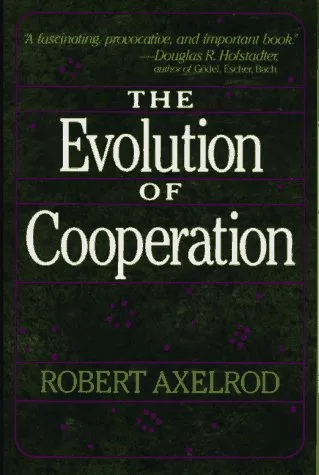
Welcome to a deeper understanding of cooperation, conflict, and the strategic interactions that shape human behavior and society. In "The Evolution of Cooperation," Robert Axelrod explores the fascinating dynamics of collaboration, even in environments where competition initially seems inevitable. Through the lens of game theory and the famous "Prisoner's Dilemma," this intellectual journey provides actionable insights into how cooperation might emerge and thrive in complex systems.
"The Evolution of Cooperation" delves into a fundamental question: how can cooperation emerge in a world where individuals act in their own self-interest? By focusing on the Prisoner's Dilemma—an iconic model in game theory—Axelrod provides a framework to study strategies for cooperation in a competitive environment. The book illustrates that under the right conditions, cooperation is not only possible but can sustain itself over time, even in scenarios where distrust runs high.
Axelrod organizes the book around experiments and simulations of repeated interactions, showing how a simple strategy called "Tit for Tat" became incredibly successful. This strategy, which involves cooperating on the first move and then replicating the previous action of the opponent in subsequent rounds, exemplifies how mutual cooperation can outcompete selfish behavior in the long term. The findings from Axelrod's research challenge conventional wisdom and offer compelling evidence that trust and reciprocity can triumph, even in environments characterized by competition.
Beyond the game-theory framework, Axelrod's work has broad implications in disciplines ranging from biology and political science to sociology and economics. From evolutionary biology to international diplomacy, the principles of sustained cooperation revealed in this book illuminate real-world scenarios where understanding cooperative dynamics is critical.
"The foundation of cooperation is not really trust, but the durability of the relationship."
"In a world where the individuals are striving for their own survival and reproduction, cooperation can nevertheless emerge."
"The key to doing well lies not in overcoming others, but in eliciting their cooperation."
"The Evolution of Cooperation" matters because it provides a blueprint for understanding the mechanisms behind successful collaboration, even in seemingly antagonistic circumstances. In a world increasingly marked by division and distrust, the lessons in this book are more relevant than ever. Axelrod's rigorous experiments with the Prisoner's Dilemma bring hope that cooperation is not only possible but can emerge naturally under certain conditions.
The interdisciplinary implications of the book make it a treasure trove for academics, policymakers, economists, and anyone interested in addressing conflicts productively. Whether applied to business negotiations, international peacekeeping efforts, or personal relationships, the insights presented in "The Evolution of Cooperation" provide both the theoretical basis and practical tools for fostering collaboration. By understanding the dynamics Axelrod describes, we gain the ability to create systems where honest, reciprocal, and sustainable interactions flourish.
This book has stood the test of time as a definitive guide to understanding not only why cooperation matters but also how it works—and how it can be cultivated in a wide range of contexts.
Your question is answered in the context of this title and author. Each answer uses 2 points.
0 reviews, 4.5 average out of 5
Sign in to publish a review.
Ask a focused question and learn from the community.
Related references that continue this learning path.
Readtrepreneur Publishing


J. Wright (Editor),M.L. Leonard (Editor)