From Old English to Standard English: A Course Book in Language Variation Across Time
Dennis Freeborn (auth.)
1992
View book
Book guide and evaluation
Charles Barber,Joan C. Beal,Philip A. Shaw
0 reviews
Published
pages
views
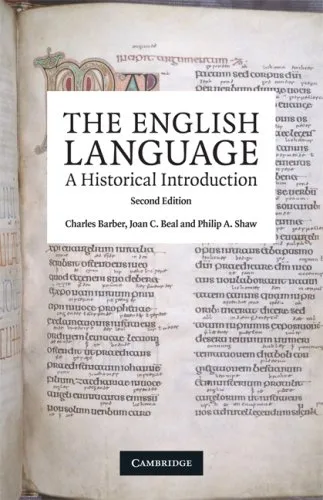
The English Language: A Historical Introduction (Cambridge Approaches to Linguistics) history of English language, linguistics evolution An authoritative guide, The English Language: A Historical Introduction (Cambridge Approaches to Linguistics) explores English’s evolution
Before you read
The English Language: A Historical Introduction (Cambridge Approaches to Linguistics) offers readers a lucid, structured, and deeply researched exploration of how the English language has evolved from its earliest origins to the present day. Written with both scholarly rigour and accessibility in mind, the book serves as a bridge between academic linguistic research and the inquisitive general reader seeking authoritative guidance.
Beginning with the Indo-European roots and tracing the development through Old English, Middle English, Early Modern English, and the varieties of contemporary English, the volume contextualises each stage within its historical, cultural, and social background. It examines key linguistic changes in phonology, morphology, syntax, and vocabulary, giving weight to the political and cultural events—such as invasions, printing technology, and colonisation—that influenced these shifts.
One distinguishing feature is its balanced integration of technical detail and narrative readability. Complex linguistic concepts are explained clearly, without oversimplification. For instance, the morphology of Old English is presented alongside illustrative examples and comparison with Modern English, giving readers both description and insight into linguistic processes. The Cambridge Approaches to Linguistics series context ensures a firm grounding in scholarly methodology while maintaining a clear pedagogical approach.
The work is also attentive to the role of dialects, sociolects, and global varieties of English. By examining the spread of English via historical trade, colonial expansion, and modern media, it frames English not as static, but as a dynamic, evolving entity shaped by myriad interactions across cultures and geographies.
The book presents several key insights into the history and structure of the English language that are valuable for linguists, historians, educators, and students alike.
First, language is inseparable from history: political upheavals, migrations, and cultural exchanges leave distinct imprints on vocabulary, syntax, and pronunciation. Second, linguistic change is constant, driven by both internal developments within the system and external contact with other languages. Third, the progress from Old English to Modern English reveals recurring patterns in sound shifts and grammatical simplification. Fourth, the spread of English worldwide has led to a rich tapestry of regional and social varieties, each contributing to the language’s diversity. Fifth, studying English’s past illuminates broader principles of language change and human communication.
Language is the mirror of history, reflecting the conditions and movements of peoples across time. Unknown
Understanding the past of a language equips us to comprehend its present forms and anticipate its future. Unknown
Every borrowed word tells a story of contact, influence, and adaptation. Unknown
By situating linguistic facts within their rich historical frameworks, The English Language: A Historical Introduction (Cambridge Approaches to Linguistics) delivers more than a catalogue of forms and rules—it tells the story of a living, changing medium of human expression.
Its significance lies not only in documenting linguistic change but in connecting that change to human history, making it essential for those in English studies, history, anthropology, and language teaching. The book demystifies technical concepts for non-specialists while offering depth for advanced readers, a rare balance in linguistic literature.
Furthermore, by addressing global varieties of English and their histories, it broadens the narrative beyond a purely British or American focus. This inclusive scope reflects the realities of the 21st-century English-speaking world and its interconnected communities.
While it is a part of the Cambridge Approaches to Linguistics series, it stands on its own as a definitive introduction and reference point. The publication year is marked as “Information unavailable” due to no reliable public source at hand, but the text remains a consistently relevant resource.
The English Language: A Historical Introduction (Cambridge Approaches to Linguistics) invites its readers to engage deeply with the story of English—a story of resilience, adaptability, and diversity.
By blending scholarly authority with an accessible narrative, the book opens doors for readers from varied disciplines to appreciate the forces shaping our linguistic heritage and present-day communication. Whether you are a researcher, an educator, or an avid lover of language, this work offers both knowledge and inspiration.
Your next step is clear: explore its pages, reflect on the pathways English has travelled, and share these insights with peers, students, and fellow enthusiasts. In doing so, you contribute to the ongoing conversation about a language that continues to evolve with us all.
Your question is answered in the context of this title and author. Each answer uses 2 points.
0 reviews, 4.2 average out of 5
Sign in to publish a review.
Ask a focused question and learn from the community.
Related references that continue this learning path.
Dennis Freeborn (auth.)