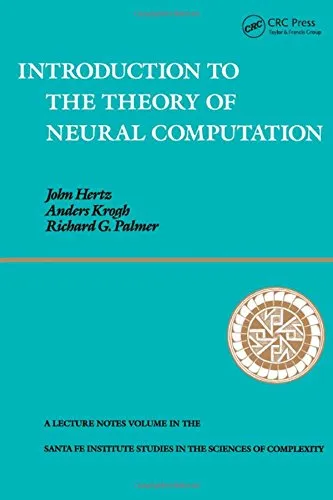
Introduction To The Theory Of Neural Computation
John A. Hertz,Anders S. Krogh,Richard G. Palmer
1991,2018
View book
Book guide and evaluation
Trevor Hastie;Robert Tibshirani;Jerome Friedman
0 reviews
Published
pages
views
Introduction to the Book Welcome to "The Elements of Statistical Learning: Data Mining, Inference, and Prediction, Second Edition," an authoritative guide to understanding the evolving field of statistical learning and data mining. Authored by celebrated statisticians Trev
Before you read
Welcome to "The Elements of Statistical Learning: Data Mining, Inference, and Prediction, Second Edition," an authoritative guide to understanding the evolving field of statistical learning and data mining. Authored by celebrated statisticians Trevor Hastie, Robert Tibshirani, and Jerome Friedman, this book offers readers a comprehensive overview of statistical learning techniques in a rapidly advancing data-driven world.
This seminal work delves into the fundamental concepts and methodologies of statistical learning, illustrating their relevance in data mining and prediction. "The Elements of Statistical Learning" is designed for professionals, researchers, and students keen on exploring the depths of statistical modeling and pattern recognition. The book's second edition builds upon the success of its predecessor by augmenting existing chapters and adding new material reflecting recent developments in the field.
Among the topics covered are supervised learning and unsupervised learning, including linear regression, classification, clustering, neural networks, ensemble methods, and more. Major algorithms such as CART, boosting, and support vector machines are dissected, reflecting the authors' goal to ensure clarity and provide practical insights into their application. The book emphasizes understanding the "why" behind each method, aiming to equip readers with both foundational and advanced knowledge essential for their practical usage.
"The aim of supervised learning is to predict the value of an outcome measure based on a number of input measures."
"Statistical learning refers to a set of tools for modeling and understanding complex datasets."
"The right method for each problem should be chosen on the basis of a principled approach guided by the data structure, problem constraints, and domain knowledge."
In today's data-rich environment, the ability to extract meaningful insights from large datasets is invaluable across various sectors, including business, healthcare, finance, and technology. "The Elements of Statistical Learning" stands out as a crucial resource due to its expert blend of theory and practical knowledge. The authors, each a luminary in the field of statistics, offer readers not only a textbook but a roadmap tailored to navigating the challenging yet rewarding landscape of data analysis.
The book's focus on statistical reasoning over rote memorization of algorithms strengthens the reader's capacity to tackle new and unseen challenges. By emphasizing intuition and theory, it empowers readers to develop robust analytical skills, enabling them to decipher complex data patterns and enforce better decision-making models.
This volume's relevance continues to grow as global reliance on data-driven insights swells, making it an indispensable resource for anyone involved in or aspiring to enter data-centric domains.
Your question is answered in the context of this title and author. Each answer uses 2 points.
0 reviews, 4.7 average out of 5
Sign in to publish a review.
Ask a focused question and learn from the community.
Related references that continue this learning path.
John A. Hertz,Anders S. Krogh,Richard G. Palmer