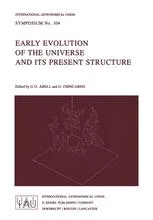
Early Evolution of the Universe and its Present Structure
J. H. Oort (auth.),G. O. Abell,G. Chincarini (eds.)
1983
View book
Book guide and evaluation
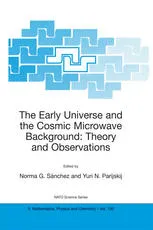
H. J. de Vega (auth.),Norma G. Sà nchez,Yuri N. Parijskij (eds.)
0 reviews
Published
pages
views
Introduction to "The Early Universe and the Cosmic Microwave Background: Theory and Observations" "The Early Universe and the Cosmic Microwave Background: Theory and Observations" serves as an essential guide for anyone fascinated with the brilliant tapestry of
Before you read
"The Early Universe and the Cosmic Microwave Background: Theory and Observations" serves as an essential guide for anyone fascinated with the brilliant tapestry of the cosmos, the origins of the universe, and the science that underpins our understanding of the cosmic microwave background (CMB). This work offers profound insights into the physical principles governing the cosmos, seamlessly blending theoretical underpinnings with observational advancements, making it a standout text for students, researchers, and enthusiasts alike.
The book bridges the gap between pioneering theories of the early universe and modern observational data, exploring how fundamental physics and astronomy intersect to unveil the mysteries of our existence. It presents a comprehensive explanation of the CMB, the afterglow of the Big Bang, and examines how it continues to shape cosmological research. Let's delve into what makes this book both illuminating and indispensable.
The book meticulously navigates through the intricate tapestry of early universe cosmology and its observational counterpart, the cosmic microwave background. It begins by addressing the critical stages of the early universe, discussing key phenomena such as inflation, baryogenesis, and primordial nucleosynthesis, which shaped the universe as we see it today. Each topic is presented with clarity, making the scientific content accessible to newcomers while maintaining depth for seasoned readers.
The authors also provide an in-depth discussion of the cosmic microwave background, detailing how this relic radiation from the Big Bang holds the keys to decoding the cosmos. Key aspects such as the anisotropies observed in the CMB, their role in revealing the large-scale structure of the universe, and the intricate linkage with dark matter and dark energy are systematically examined. The integration of up-to-date observational data from major missions, such as WMAP and Planck, adds authenticity and relevance to the discussions.
Moreover, the book explores the interplay between theoretical models and observational constraints. It emphasizes how the ever-expanding scope of technology and data collection has led to groundbreaking discoveries, refining our knowledge of cosmology. This careful blending of theory and observations fosters a deeper understanding of the field, imploring readers to appreciate both the simplicity and complexity of universal mechanisms.
"The cosmic microwave background is not just a whisper from the Universe's infancy; it is the very blueprint of its birth, an imprint of evolution across time and space."
"In the study of the early universe, theory and observation are like two lenses of a pair of spectacles—only together can we see the cosmos clearly."
Understanding the origins and nature of our universe has long been one of humanity's most profound quests. This book matters because it serves as both a stepping stone and a roadmap for that journey. By demystifying the cosmic microwave background, a fundamental observable in cosmology, the authors unlock a crucial piece of the puzzle of our genesis. Moreover, the book contributes to fostering interdisciplinary connections, bridging theoretical physics, observational astronomy, and cosmology into a coherent narrative.
Beyond its scholarly importance, the book inspires curiosity. It challenges readers to think deeply about the universe's ultimate questions: Why are we here? How did the cosmos come into being? Where is it headed? By addressing these queries with rigor and clarity, the authors highlight the intrinsic value of science and its potential to enhance our understanding of existence.
This comprehensive yet approachable text equips the current and next generations of scientists and thinkers with the tools and knowledge to advance our understanding of the cosmos. It underscores why such knowledge is not confined to academia but is part of the shared human experience.
Your question is answered in the context of this title and author. Each answer uses 2 points.
0 reviews, 4.5 average out of 5
Sign in to publish a review.
Ask a focused question and learn from the community.
Related references that continue this learning path.
J. H. Oort (auth.),G. O. Abell,G. Chincarini (eds.)
Igor Tolstikhin,Jan Kramers