

Book guide and evaluation
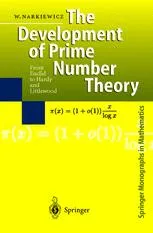
The Development of Prime Number Theory: From Euclid to Hardy and Littlewood
Władysław Narkiewicz (auth.)
English
Beginner
Mathematics
4.5 / 5
0 reviews
2000
Published
456
pages
375
views
Introduction The Development of Prime Number Theory: From Euclid to Hardy and Littlewood is a detailed exploration of one of the most fascinating topics in mathematics: the theory of prime numbers. Written by Władysław Narkiewicz, this book chronicles the historical progre
Before you read
What will you get from this book?
Introduction
The Development of Prime Number Theory: From Euclid to Hardy and Littlewood is a detailed exploration of one of the most fascinating topics in mathematics: the theory of prime numbers. Written by Władysław Narkiewicz, this book chronicles the historical progression of prime number theory, delving into the contributions of some of the greatest minds in mathematical history. From the ancient insights of Euclid to the groundbreaking work of 20th-century giants like G.H. Hardy and J.E. Littlewood, the book unveils how prime number theory evolved over millennia to become the elegant, sophisticated branch of mathematics it is today.
Prime numbers are the building blocks of mathematics, and their mysterious properties have captivated both professional mathematicians and enthusiasts for centuries. Through this book, readers will uncover the milestones in theoretical progress, the ingenuity of individual mathematicians, and the gradual emergence of collaborative advancements in prime number theory. The text provides a comprehensive historical perspective, enriched by mathematical rigor and historical context, making it an invaluable resource for students, researchers, and anyone fascinated by the beauty of numbers.
Detailed Summary
In this book, Władysław Narkiewicz masterfully traces the development of ideas in prime number theory while highlighting their connections to other areas of mathematics. Spanning over two millennia, the narrative begins with Euclid's proof of the infinitude of primes, a cornerstone of number theory and one of the earliest instances of mathematical rigor. The book then transitions into the Middle Ages, shedding light on how prime numbers were viewed during this period and how intellectual curiosity about their nature began to take shape.
The Renaissance and Enlightenment periods brought transformative changes, as luminaries like Fermat and Euler introduced novel concepts and techniques, such as congruences and modular arithmetic, that laid the groundwork for modern number theory. Narkiewicz meticulously explains the significance of their contributions, emphasizing Euler's elegant methods and Fermat's pioneering studies. The narrative then guides readers through the 19th century, an era marked by profound growth in mathematical understanding. Figures like Gauss, Dirichlet, and Riemann extended the scope of prime number theory, with Riemann's hypothesis on the zeta function becoming one of the most enigmatic and influential ideas in mathematics.
The 20th century witnessed a revolutionary transformation in techniques and collaborations. Hardy and Littlewood, through their celebrated partnership, introduced analytic methods that propelled prime number theory into its modern form. The foundational questions posed by earlier mathematicians began to intertwine with deeper and more abstract structures, giving rise to new subfields and conjectures. The book weaves all these threads together into a cohesive historical journey, demonstrating how incremental contributions over time coalesce into profound mathematical achievements.
Key Takeaways
- The evolution of prime number theory is deeply intertwined with the broader development of mathematics as a discipline.
- Key figures like Euclid, Euler, Riemann, Hardy, and Littlewood revolutionized our understanding of primes through rigorous proofs and groundbreaking ideas.
- Modern techniques, including analytic approaches and computational tools, owe their origins to centuries of earlier mathematical work.
- The study of prime numbers continues to be a vibrant field with unsolved problems, such as the Riemann Hypothesis, still driving research today.
Famous Quotes from the Book
"Prime numbers are more than just numbers; they are the keys to the deeper mysteries of mathematics."
"Observing the history of prime number theory reveals that mathematical discoveries are not made in isolation but through the cumulative efforts of many individuals over time."
Why This Book Matters
The significance of The Development of Prime Number Theory extends beyond its audience of mathematicians and historians of mathematics. It serves as a bridge between the past and the present, illuminating how mathematical thinking evolves and how interconnected the field truly is. By examining the intricate tapestry of ideas and breakthroughs, the book encourages readers to appreciate the persistence, creativity, and intellectual rigor that underpin mathematical progress.
For researchers, the book provides valuable insights into the origins and technical details of key discoveries in prime number theory. For students, it acts as an inspiring introduction to mathematical history, showing how even the most abstract ideas have practical roots and profound implications. Lastly, for the general audience, it demonstrates how humanity’s pursuit of knowledge about something as fundamental as prime numbers can give rise to stunningly diverse and ingenious ideas. Ultimately, this book emphasizes that the development of prime number theory is not just a narrative of mathematics but a testament to human curiosity and the power of collective effort.
Ask this book
Your question is answered in the context of this title and author. Each answer uses 2 points.
Sign in to ask the book assistant.
Reader reviews
0 reviews, 4.5 average out of 5
No reviews yet
If you have read this book, help the next reader with your experience.
Write a review
Sign in to publish a review.
Reader questions and answers
Ask a focused question and learn from the community.
Sign in to ask or answer a question.
No questions yet
Be the first to ask a clear, useful question.
What to read next
Related references that continue this learning path.


Modern Computer Vision with PyTorch: A Practical Roadmap From Deep Learning Fundamentals to Advanced Applications and Generative AI, 2nd Edition
V Kishore Ayyadevara,Yeshwanth Reddy
2023
View book