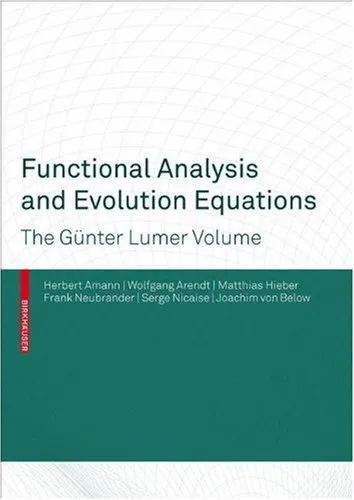
Functional analysis and evolution equations: The Gunter Lumer volume
Herbert Amann,Wolfgang Arendt,Matthias Hieber,Frank Neubrander,Serge Nicaise,Joachim Below
2008
View book
Book guide and evaluation
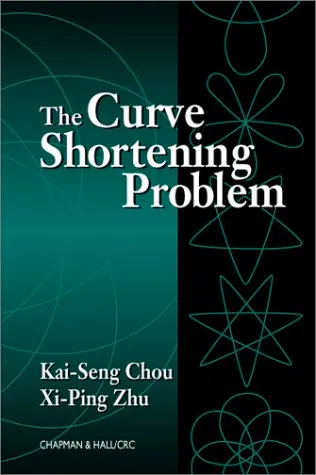
Kai-Seng Chou,Xi-Ping Zhu
0 reviews
Published
pages
views
Introduction to 'The Curve Shortening Problem' Geared towards mathematicians, researchers, and advanced students, 'The Curve Shortening Problem' by Kai-Seng Chou and Xi-Ping Zhu provides an in-depth exploration of one of the most celebrated topics in differential geometry. Thi
Before you read
Geared towards mathematicians, researchers, and advanced students, 'The Curve Shortening Problem' by Kai-Seng Chou and Xi-Ping Zhu provides an in-depth exploration of one of the most celebrated topics in differential geometry. This book serves as a comprehensive guide to understanding the mathematical phenomena surrounding curve shortening flow, a process where curves evolve over time to reduce their length. Whether you're a novice delving into geometric flows for the first time or an expert seeking to sharpen your knowledge, this book offers unmatched clarity, rigor, and insight into the subject.
At the core of this book lies the fascinating study of how curves evolve under the influence of their curvature. The curve shortening problem, also known as curve shortening flow (CSF), describes a process where smooth plane curves are deformed in the direction of their inward normal vector, with speed proportional to their curvature. The authors masterfully outline the mathematical framework necessary for tackling this problem, starting from foundational differential geometry concepts and progressing to advanced results.
The book is divided into a series of well-structured chapters. It begins with a rigorous derivation of the curve shortening flow equations and an intuitive explanation of their geometric significance. Techniques from analysis, geometry, and partial differential equations are seamlessly interwoven to provide a multifaceted perspective on this dynamic process. Key results, such as the famous Gage-Hamilton-Grayson theorem (which states that simple closed curves under CSF collapse into a round point), are given prominent attention, along with the intricate proofs behind them.
The authors also delve into related geometric phenomena, including singularity formation, maximum principles, isoperimetric inequalities, and behavior in higher dimensions. Each topic is thoroughly addressed through rigorous proofs, illustrative examples, and exercises designed to deepen comprehension. The comprehensive nature of the book caters well to both pure mathematicians eager to explore the theoretical aspects and applied scientists interested in practical applications like image processing or material science.
"The curve shortening flow encapsulates elegance in evolution—an interplay of geometry and analysis as curves bend, smooth, and simplify."
"The simplicity of a closed curve belies the complexity of the mathematics required to describe its behavior under shortening flow."
"Studying the curve shortening flow not only reveals deep mathematical phenomena but also enhances our understanding of nature's optimization processes."
The study of geometric flows, including the curve shortening problem, plays a pivotal role in understanding the evolution of shapes in mathematics and applied sciences. This book matters because it bridges the gap between abstract theory and applicable results in differential geometry. The authors have meticulously structured the content to provide both theoretical depth and practical utility, making it a valuable asset for mathematicians honing their craft or practitioners leveraging geometric evolution in real-world applications.
Additionally, the curve shortening flow has significant consequences in diverse areas of research. For example, in computer vision, ideas from CSF are applied to smooth out boundaries in image processing. In physics, it models heat diffusion and other natural phenomena. By reading 'The Curve Shortening Problem', one gains not only an appreciation for the mathematical elegance underpinning these phenomena but also a toolkit for solving related research problems.
Ultimately, this book serves as both an authoritative introduction to and an advanced discussion of one of the most compelling topics in modern mathematics.
Your question is answered in the context of this title and author. Each answer uses 2 points.
0 reviews, 4.5 average out of 5
Sign in to publish a review.
Ask a focused question and learn from the community.
Related references that continue this learning path.
Herbert Amann,Wolfgang Arendt,Matthias Hieber,Frank Neubrander,Serge Nicaise,Joachim Below
Lars Hörmander (auth.)