From Old English to Standard English: A Course Book in Language Variation Across Time
Dennis Freeborn (auth.)
1992
View book
Book guide and evaluation
Denise Helly
0 reviews
Published
pages
views
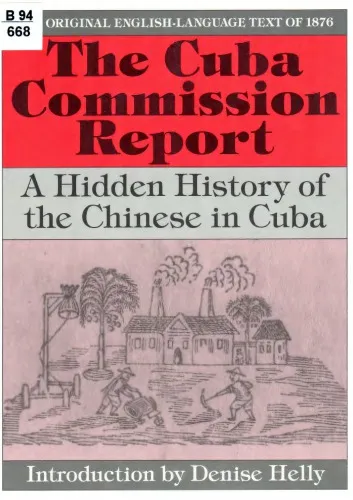
The Cuba Commission Report: A Hidden History of the Chinese in Cuba. The Original English-Language Text of 1876 Chinese indentured labor in Cuba, 19th-century Caribbean history Explore The Cuba Commission Report: A Hidden History of the Chinese in Cuba. The Original Eng
Before you read
Published in 1876, The Cuba Commission Report: A Hidden History of the Chinese in Cuba. The Original English-Language Text of 1876 stands as a rare, unvarnished account of one of the least examined chapters in Caribbean and global labor history: the experiences of Chinese indentured workers in Cuba during the 19th century.
This original English-language text was produced by the commissioners tasked with investigating the conditions under which thousands of Chinese laborers lived and worked in Cuban plantations. The report reveals a stark reality—one marked by harsh contracts, grueling labor, and systematic abuses—providing a crucial primary source for historians, sociologists, and legal scholars alike.
While the narratives of African enslavement in the Americas have rightly received significant scholarly attention, the parallel stories of Asian indentured labor are often overshadowed. This book’s careful transcription and contextual framing offers a gateway into comprehending the intersecting forces of imperial economics, migration policy, and human rights abuses in the colonial Caribbean. Although contemporary citations often refer to excerpts, having access to the full original 1876 text allows modern readers to engage directly with the language, tone, and investigative approach of the era, free of later editorial filters.
Readers will gain not only historical detail but also critical insight into broader themes of labor exploitation, racial dynamics, and colonial governance.
First, the text lays bare the mechanisms through which Chinese laborers were recruited under contract in Southern China, shipped across oceans, and then subjected to quasi-slavery in Cuban sugar estates.
Second, it documents the voices of witnesses and commissioners, providing an official yet humanized record invaluable to scholars seeking primary evidence.
Third, the report stimulates comparative analysis with other indentured experiences, such as Indian labor in the Caribbean, fostering a global understanding of diasporic labor history.
Finally, it invites reflection on the legal frameworks and international oversight mechanisms of the time, many of which failed to protect vulnerable migrant populations.
“The contracts, though signed willingly, were entered into under circumstances that cannot be regarded as free.” Unknown
“Their testimonies are a mirror to suffering, yet also to resilience.” Unknown
“This report is not merely an account—it is an indictment of a system.” Unknown
In scholarly and professional discourse, the value of this book is amplified by its authenticity and specificity.
By presenting the original English-language text, this edition ensures that contemporary readers can grapple with the precise wording and framing used by the 19th-century commission. For researchers studying transnational labor migration, the Chinese diaspora, or the socio-economic structures of colonial Cuba, the document offers irreplaceable evidence.
Furthermore, the work contributes to ongoing discussions in postcolonial studies, international labor law, and human rights advocacy by demonstrating how past injustices continue to echo in modern migration and labor practices.
Information about any awards or contemporary reception data remains unavailable due to the absence of reliable public sources documenting such aspects from the 19th century.
For historians, sociologists, and engaged readers, The Cuba Commission Report: A Hidden History of the Chinese in Cuba. The Original English-Language Text of 1876 is more than an archive—it is a living document that challenges us to see connections between past and present.
By immersing yourself in its pages, you engage in a dialogue with history, one that confronts exploitation while honoring the voices of those who endured it. This is an invitation to read closely, share insights with peers, and discuss the ongoing relevance of labor rights in global contexts. Let this seminal report guide your next scholarly pursuit or informed conversation.
Your question is answered in the context of this title and author. Each answer uses 2 points.
0 reviews, 4.6 average out of 5
Sign in to publish a review.
Ask a focused question and learn from the community.
Related references that continue this learning path.
Dennis Freeborn (auth.)