
Thermodynamics ; Fundamental Principles and Applications (UNITEXT for Physics)
Antonio Saggion,Rossella Faraldo,Matteo Pierno
2019
View book
Book guide and evaluation
Hong Wei Xiang
0 reviews
Published
pages
views
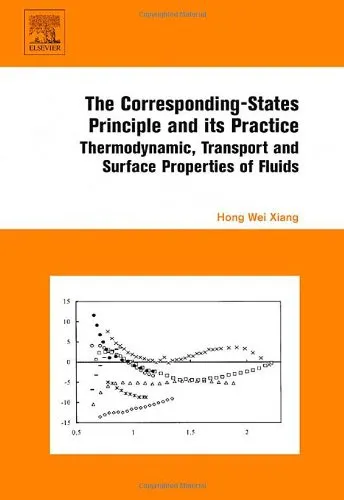
Welcome to the comprehensive introduction to "The Corresponding-States Principle and Its Practice: Thermodynamic, Transport, and Surface Properties of Fluids" by Hong Wei Xiang. This book serves as a detailed exploration into the fascinating world of fluid thermodynamics,
Before you read
Welcome to the comprehensive introduction to "The Corresponding-States Principle and Its Practice: Thermodynamic, Transport, and Surface Properties of Fluids" by Hong Wei Xiang. This book serves as a detailed exploration into the fascinating world of fluid thermodynamics, presenting both theoretical foundations and practical applications with a rigorous approach.
In this book, Hong Wei Xiang meticulously dissects the Corresponding-States Principle (CSP), a pivotal concept in the thermodynamic analysis of fluids. The CSP provides a framework for predicting the thermodynamic properties of fluids based on a reduced number of independent variables, facilitating the simplification of complex calculations. This principle, tracing its roots back to the early 20th century, has evolved to offer critical insights across a multitude of scientific disciplines, including chemical engineering, physics, and materials science.
The book is structured to first introduce the fundamental theories and historical evolution of the Corresponding-States Principle. It then delves into detailed methodologies for applying CSP in predicting thermodynamic properties such as compressibility, viscosity, and thermal conductivity of various fluids. A significant portion of the text is dedicated to exploring transport properties and surface phenomena, reflecting the increasing relevance of interfacial effects in modern technological applications.
Deftly combining theoretical discussions with empirical evidence, the text illustrates numerous case studies and practical examples. This strategic integration ensures that readers not only grasp the underlying principles but also gain invaluable insights into their practical implementation in industrial scenarios.
"The Corresponding-States Principle serves as a bridge, connecting complex theoretical landscapes with pragmatic engineering challenges."
"Beyond the equations and theories lies a deeper understanding of the fluid universe—a realm where simplicity and complexity coalesce harmoniously."
As our world pushes the boundaries of technological innovation and environmental stewardship, understanding the behavior of fluids at various scales has never been more crucial. "The Corresponding-States Principle and Its Practice" stands as a significant contribution to this endeavor, offering a robust educational guide and a profound resource for researchers and professionals alike.
What makes this book particularly vital is its dedication to not only outlining the Corresponding-States Principle but also demonstrating its efficacy in solving pressing real-world problems. Whether you are a seasoned academic, a practicing chemical engineer, or an aspiring student, the insights and methodologies presented in this text offer foundational knowledge which can be applied to enhance efficiency, innovation, and sustainability in processes involving fluid technologies.
In conclusion, Hong Wei Xiang's book is more than a mere academic text; it is a crucial tool for integrating scientific theories with industrial hands-on practices, ultimately fostering a deeper understanding of the physical and chemical properties that govern fluid behavior.
Your question is answered in the context of this title and author. Each answer uses 2 points.
0 reviews, 5.0 average out of 5
Sign in to publish a review.
Ask a focused question and learn from the community.
Related references that continue this learning path.
Antonio Saggion,Rossella Faraldo,Matteo Pierno

Stanley I. Sandler