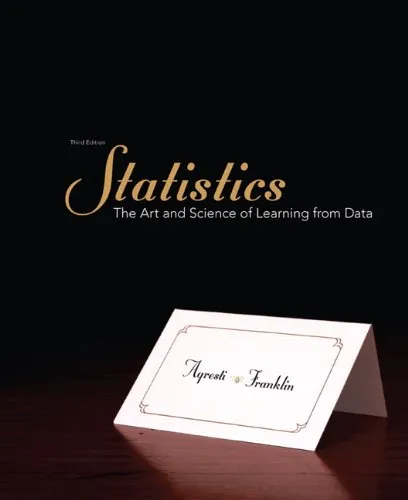
Statistics: The Art and Science of Learning from Data
Alan Agresti,Christine Franklin
2012
View book
Book guide and evaluation
J Frauendiener;H Friedrich
0 reviews
Published
pages
views
Introduction to "The Conformal Structure of Space-Time: Geometry, Analysis, Numerics" Space-time, the fabric of the universe, is far more intricate and fascinating than initially imagined. In The Conformal Structure of Space-Time: Geometry, Analysis, Numerics, au
Before you read
Space-time, the fabric of the universe, is far more intricate and fascinating than initially imagined. In The Conformal Structure of Space-Time: Geometry, Analysis, Numerics, authors J. Frauendiener and H. Friedrich take readers on an elaborate journey through the interplay of geometry, analysis, and numerical methods in understanding the cosmos. This book dives into the core mathematical structure underlying Einstein's theory of General Relativity, focusing on the significance of conformal geometry as a framework.
This text is not only a theoretical exploration but also provides a numerical and analytical foundation to tackle the challenges posed when expanding our understanding of space-time. Whether you are a mathematician, physicist, or computational scientist, this book offers unparalleled insights into one of the most profound aspects of modern theoretical physics.
The book begins by introducing the mathematical foundations of conformal geometry, setting the stage for its role in describing the properties of space-time. Conformal geometry, which concerns angle-preserving transformations, provides a deeper understanding of the infinite structures of the universe while ensuring compatibility with Einstein's equations.
One of the core themes is the role of conformal compactifications, a technique in which infinity is brought to a finite point, providing profound insights into the asymptotic structure of space-times. This concept simplifies the study of gravitational waves, black holes, and cosmological structures by enabling a comprehensive description of their behavior near infinity.
Through rigorous derivations and detailed explanations, the authors provide solutions to Einstein's equations in a conformal setting, tackling problems related to stability, singularities, and boundary conditions. Emphasis is placed on the interplay between theoretical constructs and practical computations, bridging the gap for mathematicians and physicists alike.
Later chapters delve into numerical techniques aimed at solving field equations in conformal settings. By addressing common computational obstacles, the authors provide indispensable tools for researchers to apply theoretical constructs in modeling real-world scenarios. The final sections of the book seamlessly integrate numerical analysis and modern geometric techniques, highlighting their ability to unravel the mysteries of both classical and quantum gravitational phenomena.
“The structure of space and time is not merely a backdrop for physical phenomena but the very medium through which the universe manifests its fundamental laws.”
“In the infinite reaches of space-time, conformal geometry brings clarity and order to what would otherwise seem like chaos.”
At its core, The Conformal Structure of Space-Time addresses some of the most profound questions in theoretical physics and mathematics. In an era where precision in modeling space-time phenomena is critical—whether for detecting gravitational waves or understanding the behavior of black holes—this book offers foundational tools for both theoretical breakthroughs and practical applications.
By bringing together geometry, analysis, and numerics, this text bridges the gap between abstract mathematics and empirical science, making it a must-read for researchers, educators, and students pursuing advanced studies in General Relativity, cosmology, and computational physics. Its relevance extends beyond academia, providing a framework for understanding the universe's infinite complexity and beauty.
Your question is answered in the context of this title and author. Each answer uses 2 points.
0 reviews, 4.5 average out of 5
Sign in to publish a review.
Ask a focused question and learn from the community.
Related references that continue this learning path.
Alan Agresti,Christine Franklin