Book guide and evaluation
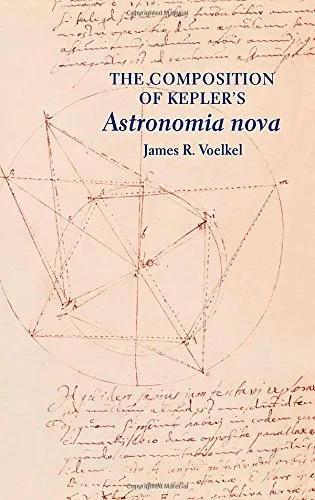
The Composition of Kepler’s Astronomia nova.
James R. Voelkel
English
Unordered
Art
5.0 / 5
0 reviews
2001
Published
315
pages
219
views
This is one of the most important studies in decades on Johannes Kepler, among the towering figures in the history of astronomy. Drawing extensively on Kepler's correspondence and manuscripts, James Voelkel reveals that the strikingly unusual style of Kepler's magnum opus, Astron
Before you read
What will you get from this book?
This is one of the most important studies in decades on Johannes Kepler, among the towering figures in the history of astronomy. Drawing extensively on Kepler's correspondence and manuscripts, James Voelkel reveals that the strikingly unusual style of Kepler's magnum opus, Astronomia nova (1609), has been traditionally misinterpreted. Kepler laid forth the first two of his three laws of planetary motion in this work. Instead of a straightforward presentation of his results, however, he led readers on a wild goose chase, recounting the many errors and false starts he had experienced. This had long been deemed a ''confessional'' mirror of the daunting technical obstacles Kepler faced. As Voelkel amply demonstrates, it is not. Voelkel argues that Kepler's style can be understood only in the context of the circumstances in which the book was written. Starting with Kepler's earliest writings, he traces the development of the astronomer's ideas of how the planets were moved by a force from the sun and how this could be expressed mathematically. And he shows how Kepler's once broader research program was diverted to a detailed examination of the motion of Mars. Above all, Voelkel shows that Kepler was well aware of the harsh reception his work would receive--both from Tycho Brahe's heirs and from contemporary astronomers; and how this led him to an avowedly rhetorical pseudo-historical presentation of his results. In treating Kepler at last as a figure in time and not as independent of it, this work will be welcomed by historians of science, astronomers, and historians.
Ask this book
Your question is answered in the context of this title and author. Each answer uses 2 points.
Sign in to ask the book assistant.
Reader reviews
0 reviews, 5.0 average out of 5
No reviews yet
If you have read this book, help the next reader with your experience.
Write a review
Sign in to publish a review.
Reader questions and answers
Ask a focused question and learn from the community.
Sign in to ask or answer a question.
No questions yet
Be the first to ask a clear, useful question.
What to read next
Related references that continue this learning path.
Solutions Architect's Handbook: Kick-start your career as a solutions architect by learning architecture design principles and strategies, 2nd Edition
Saurabh Shrivastava,Neelanjali Srivastav
2022
View book
Solutions Architect's Handbook - Third Edition: Kick-start your career with architecture design principles, strategies, and generative AI techniques
Saurabh Shrivastava,Neelanjali Srivastav
2024
View book