Book guide and evaluation
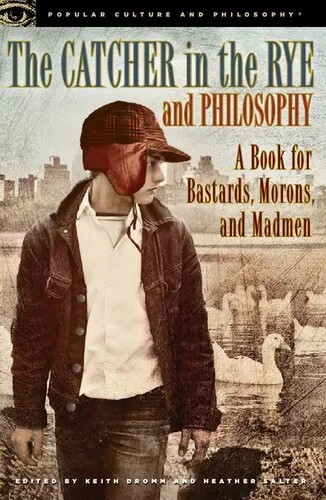
The Catcher in the Rye and Philosophy: A Book for Bastards, Morons, and Madmen (Popular Culture and Philosophy 71)
Keith Dromm (editor),Heather Salter (editor)
English
Intermediate
novel
3.5 / 5
0 reviews
2012
Published
237
pages
556
views
Welcome to the compelling world of "The Catcher in the Rye and Philosophy: A Book for Bastards, Morons, and Madmen"—a unique fusion of J.D. Salinger's classic novel with profound philosophical exploration. This book, part of the Popular Culture and Philosophy series, offers rea
Before you read
What will you get from this book?
Welcome to the compelling world of "The Catcher in the Rye and Philosophy: A Book for Bastards, Morons, and Madmen"—a unique fusion of J.D. Salinger's classic novel with profound philosophical exploration. This book, part of the Popular Culture and Philosophy series, offers readers an insightful journey into the complexities of the human condition, as explored through one of literature's most enigmatic protagonists, Holden Caulfield.
Detailed Summary of the Book
The book serves as a bridge between the seemingly disjoint realms of literature and philosophy, bringing together a collection of essays written by scholars and enthusiasts who delve into the many philosophical themes inherent in Salinger's work. "The Catcher in the Rye" is not just a coming-of-age story; it is a text rich with existential questions, moral dilemmas, and ontological inquiries. Each essay in this collection examines these dimensions with a fresh perspective, pulling from various philosophical schools of thought.
Readers will encounter discussions on existentialism as it relates to Holden's quest for authenticity in a seemingly 'phony' world. The text also addresses psychological dimensions, such as alienation and self-identity, and how these themes are magnified through Holden's interactions and internal monologues. Through these philosophical lenses, the essays offer a deeper understanding of Holden’s turbulent psyche and the broader societal critiques embedded in Salinger’s narrative.
Key Takeaways
- Understanding the philosophical underpinnings of Holden Caulfield's character and his existential angst.
- An exploration of themes like alienation, identity, and the search for meaning in a modern society.
- Insight into how Salinger’s work continues to resonate with contemporary philosophical debates.
- A new-found appreciation for the depth of Salinger’s characters and their relevance to philosophical inquiry.
- Inspiration to view literary works through a philosophical lens, enhancing both critical thinking and analytical skills.
Famous Quotes from the Book
While "The Catcher in the Rye and Philosophy" is a commentary on Salinger's work, it is filled with its own memorable insights. Here are a few standout reflections:
"Holden Caulfield guides us into the familiar territory of adolescent confusion, making us question the boundaries between sanity and madness, reality and illusion."
"In examining Holden's rebellion, we are invited to reconsider our own encounters with societal expectation and individual authenticity."
Why This Book Matters
This book is significant not only for fans of "The Catcher in the Rye" but also for anyone interested in the intersection of literature and philosophy. It offers a fresh, scholarly perspective on a beloved literary classic, shedding new light on why Holden Caulfield remains a powerful voice in diagnosing the ailments of modernity.
The philosophical exploration provided in this book underlines the timeless nature of Salinger's work, highlighting how literature can serve as a mirror to human struggles and societal shortcomings. It reinforces the idea that novels are not merely stories, but profound commentaries on the human experience, full of insights that surpass the confines of their pages.
For both seasoned scholars and casual readers, "The Catcher in the Rye and Philosophy" offers an enriching experience that deepens our understanding of a classic narrative while posing the critical questions that remain ever-relevant in philosophical inquiry.
Audio introductions
Persian Summary
Ask this book
Your question is answered in the context of this title and author. Each answer uses 2 points.
Sign in to ask the book assistant.
Reader reviews
0 reviews, 3.5 average out of 5
No reviews yet
If you have read this book, help the next reader with your experience.
Write a review
Sign in to publish a review.
Reader questions and answers
Ask a focused question and learn from the community.
Sign in to ask or answer a question.
No questions yet
Be the first to ask a clear, useful question.
What to read next
Related references that continue this learning path.