The Law of Corporate Finance: General Principles and EU Law: Volume II: Contracts in General
Petri Mäntysaari (auth.)
2010
View book
Book guide and evaluation
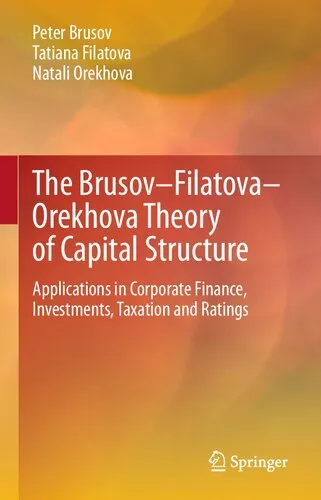
Peter Brusov,Tatiana Filatova,Natali Orekhova
0 reviews
Published
pages
views
Introduction The 'Brusov–Filatova–Orekhova Theory of Capital Structure: Applications in Corporate Finance, Investments, Taxation, and Ratings' provides an in-depth exploration of how contemporary businesses can strategically manage their capital structures to o
Before you read
The 'Brusov–Filatova–Orekhova Theory of Capital Structure: Applications in Corporate Finance, Investments, Taxation, and Ratings' provides an in-depth exploration of how contemporary businesses can strategically manage their capital structures to optimize performance and maximize value. This book is a fundamental text for scholars, practitioners, and students looking to gain a nuanced understanding of corporate finance principles applied through the innovative lens of the Brusov–Filatova–Orekhova (BFO) theory.
The Brusov–Filatova–Orekhova (BFO) theory is an evolution of traditional capital structure concepts, providing new insights beyond the classic Modigliani-Miller propositions. Our book encompasses a broad range of topics, starting with a historical perspective on capital structure theories and moving towards contemporary applications and implications of the BFO model in various fields within corporate finance.
The book meticulously covers methods to measure financial leverage impacts under varying market conditions, illuminating the complex interactions between corporate taxes, investment strategies, and risk management. It weaves through topics such as optimal funding strategies, the role of credit ratings in capital structuring, and advanced investment decision-making processes that align with the newly proposed BFO paradigms.
Emphasizing practical applications, the book offers case studies and real-world examples, demonstrating how the BFO theory can be incorporated into existing frameworks. These examples highlight successful execution in diverse industries, making the text not only a repository of knowledge but also a manual for applied finance.
"The essence of finance is not in spreadsheets or balance sheets, but in the strategic arts of value creation and risk management."
"Effective capital structuring transcends the traditional boundaries of finance theory, shaping enterprises that can endure volatility and harness growth."
As the global business environment becomes increasingly complex, the ability to strategically navigate financial markets and effectively manage capital structures is of paramount importance. This book not only revisits well-established theories but also projects them forward into the nuances of modern-day challenges. The BFO theory, with its fresh perspectives, offers a robust framework that integrates various financial aspects to better cope with contemporary issues like economic fluctuations, technology disruptions, and evolving regulatory landscapes.
The book's emphasis on the holistic application of capital structuring strategies ensures that readers not only understand the theories but also their practical implications. It serves as a vital resource for financial professionals committed to advancing their strategic acumen and for academics seeking to enrich their theoretical research with pioneering concepts.
Your question is answered in the context of this title and author. Each answer uses 2 points.
0 reviews, 4.4 average out of 5
Sign in to publish a review.
Ask a focused question and learn from the community.
Related references that continue this learning path.
Petri Mäntysaari (auth.)

Petri Mäntysaari (auth.)

Petri Mäntysaari (auth.)