
Book guide and evaluation
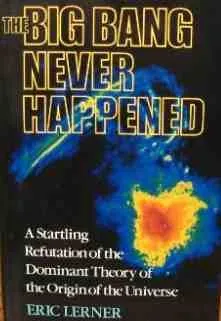
The Big Bang Never Happened: A Startling Refutation of the Dominant Theory of the Origin of the Universe
Eric Lerner
English
Beginner
Physics
3.8 / 5
0 reviews
1991
Published
456
pages
303
views
Introduction Welcome to the intriguing world of cosmology as presented in The Big Bang Never Happened: A Startling Refutation of the Dominant Theory of the Origin of the Universe by Eric Lerner. In this compelling and thought-provoking book, Lerner challenges the widely ac
Before you read
What will you get from this book?
Introduction
Welcome to the intriguing world of cosmology as presented in The Big Bang Never Happened: A Startling Refutation of the Dominant Theory of the Origin of the Universe by Eric Lerner. In this compelling and thought-provoking book, Lerner challenges the widely accepted Big Bang theory, proposing instead that the universe has existed in an alternative state. Using a combination of scientific data, historical insights, and philosophical reasoning, the book seeks to shift the paradigm in our understanding of the cosmos.
Detailed Summary of the Book
The Big Bang Never Happened critically examines the most dominating cosmological model of our time – the Big Bang theory. Lerner argues against the traditional view that the universe began 13.8 billion years ago with a massive explosion. He presents an exhaustive analysis of current physical theories and astronomical observations that suggest a different narrative, anchored in the concepts of plasma cosmology. This theory proposes a universe driven more by electromagnetic forces rather than gravity, as traditionally emphasized in cosmology.
Throughout the book, Lerner meticulously reviews anomalies and contradictions within Big Bang cosmology and posits alternative explanations driven by plasma physics. He mixes hard scientific data with historical context, pointing out how certain biases and philosophical underpinnings have influenced the reception of cosmological models. By highlighting work from scientists like Hannes Alfvén and others in the field of plasma physics, Lerner builds a case for considering a universe without a definite beginning and possibly without an end, painting a picture of a more eternal and stable cosmos.
Key Takeaways
- The Big Bang may not be the only or the most plausible explanation for the origins of the universe based on current data.
- Plasma physics offers significant insights into an alternative view of cosmic evolution.
- Scientific models are often influenced by prevailing philosophical and cultural currents, which can bias interpretations.
- Critical examination and openness to alternative cosmological theories are essential for scientific progress.
Famous Quotes from the Book
"In science, as in other areas of human endeavor, it is the unfettered play of the intellect that gives rise to new ideas."
"The most significant problems in physics and cosmology can often be solved by challenging the conventional assumptions."
Why This Book Matters
The Big Bang Never Happened serves as a seminal work in the discussion of cosmology, particularly for those questioning established scientific theories. In an era where scientific assertion is often equated with absolute truth, Lerner invites readers to consider the complex and dynamic processes behind the development of scientific theories, reminding us of the provisional nature of knowledge.
This book matters not only for its scientific hypotheses but also for its critical examination of how scientific authority is constructed and maintained. By questioning the dominant paradigms and presenting alternative hypotheses, Lerner encourages intellectual curiosity and scientific skepticism, both vital for innovative advancements in any field. Whether you're a student, researcher, or simply a curious reader, this book challenges you to think deeply about the universe's mysteries and the narratives we construct to understand them.
Ask this book
Your question is answered in the context of this title and author. Each answer uses 2 points.
Sign in to ask the book assistant.
Reader reviews
0 reviews, 3.8 average out of 5
No reviews yet
If you have read this book, help the next reader with your experience.
Write a review
Sign in to publish a review.
Reader questions and answers
Ask a focused question and learn from the community.
Sign in to ask or answer a question.
No questions yet
Be the first to ask a clear, useful question.
What to read next
Related references that continue this learning path.

Modern Computer Vision with PyTorch: A Practical Roadmap From Deep Learning Fundamentals to Advanced Applications and Generative AI, 2nd Edition
V Kishore Ayyadevara,Yeshwanth Reddy
2023
View book