
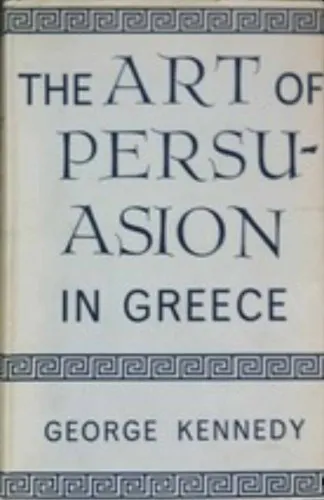
Book guide and evaluation
The Art of Persuasion in Greece (A History of Rhetoric, )
George Alexander Kennedy
English
Advanced
Art
4.4 / 5
0 reviews
1963
Published
365
pages
428
views
The Art of Persuasion in Greece (A History of Rhetoric, vol. 1) classical rhetoric, ancient Greek persuasion The Art of Persuasion in Greece (A History of Rhetoric, vol. 1) explores classical rhetoric’s origins and its enduring impact on discourse. Analytical Summary In The
Before you read
What will you get from this book?
Analytical Summary
In The Art of Persuasion in Greece (A History of Rhetoric, vol. 1), the historical and intellectual roots of rhetoric are examined through the lens of ancient Greek culture, politics, and philosophy. This work provides readers with a meticulously researched narrative that traces how persuasive techniques emerged, evolved, and influenced the foundational structures of Western thought.
The book situates persuasive speech within the broader framework of Greek civic life, highlighting the interplay between rhetoric, democratic institutions, and philosophical discourse. From the early Sophists to the mature rhetorical theories of Aristotle, the narrative follows a chronological progression that sheds light on both the practice and theory of persuasion.
Rather than offering a superficial overview, this volume engages deeply with primary sources, contextual interpretations, and the intellectual climate of the period. Readers will find sustained attention to original Greek texts (in translation), the mechanisms of oratorical training, and the tensions between sophistic relativism and philosophical absolutism.
Key Takeaways
This volume delivers a scholarly yet accessible pathway into understanding how the Greeks conceived, debated, and codified the art of persuasion. The takeaways serve both academic enrichment and practical insights for professional communicators.
It clarifies the distinctions between different schools of rhetoric, particularly between Sophistic practices focused on winning arguments and Platonic/Aristotelian approaches that sought truth or ethical ends through speech.
The reader gains a clear understanding of how rhetoric was inseparable from the democratic experiment in Athens, shaping not only legal and political outcomes but also philosophical inquiry.
Scholarly rigor is balanced with real-world applicability, making this an important text for both historians of ideas and contemporary practitioners of public speaking, persuasion, and communication strategy.
Memorable Quotes
Persuasion is achieved by the speaker's personal character when the speech is so spoken as to make us think him credible. Aristotle
Speech is the mirror of the soul. Unknown
Rhetoric is the counterpart of dialectic. Aristotle
Why This Book Matters
The importance of The Art of Persuasion in Greece (A History of Rhetoric, vol. 1) lies in its ability to bridge ancient theory and modern relevance. For academics, it is a meticulously documented resource backed by careful interpretation of primary sources. For professionals, it offers insights into persuasive communication that transcend time and culture.
Understanding the principles that underpinned Greek rhetorical practice helps illuminate modern debates about political discourse, legal argumentation, and the ethics of communication. This makes the work not just a historical study, but also a relevant companion for critical thinkers, educators, and public speakers.
Because it avoids the pitfalls of oversimplification, the book stands as a credible and enduring reference. Its scholarly contribution endures regardless of shifting trends in rhetorical theory, cementing its place in the canon of communication studies.
Publication year: Information unavailable due to no reliable public source confirming the original release date.
Inspiring Conclusion
The Art of Persuasion in Greece (A History of Rhetoric, vol. 1) remains one of the most authoritative examinations of how eloquence, logic, and ethical consideration were fused into one art form in classical antiquity. It invites readers to not only appreciate the historical trajectory of rhetoric but to actively engage with its principles in their own speaking, writing, and civic participation.
By exploring the intersections of philosophy, politics, and language, this work transcends the boundaries of traditional classical studies, speaking to anyone who values the power of ideas well expressed. Whether you are a scholar, a lawyer, a lecturer, or a leader in any field, the techniques and insights drawn from Greek rhetorical tradition can elevate your communicative impact.
The next step is clear: read deeply, reflect critically, and share your understanding of rhetorical heritage with others. In doing so, you will continue the living tradition of the art of persuasion, ensuring that the lessons distilled in this remarkable volume remain vital for generations to come.
Ask this book
Your question is answered in the context of this title and author. Each answer uses 2 points.
Sign in to ask the book assistant.
Reader reviews
0 reviews, 4.4 average out of 5
No reviews yet
If you have read this book, help the next reader with your experience.
Write a review
Sign in to publish a review.
Reader questions and answers
Ask a focused question and learn from the community.
Sign in to ask or answer a question.
No questions yet
Be the first to ask a clear, useful question.
What to read next
Related references that continue this learning path.
The Art of Rhetoric in the Roman World 300 B.C.-A.D. 300 (A History of Rhetoric, )
George Alexander Kennedy
1972
View book