
The Art of Computer Programming, Volume 4A: Combinatorial Algorithms, Part 1
Knuth,Donald Ervin
2011
View book
Book guide and evaluation
Donald E. Knuth
0 reviews
Published
pages
views
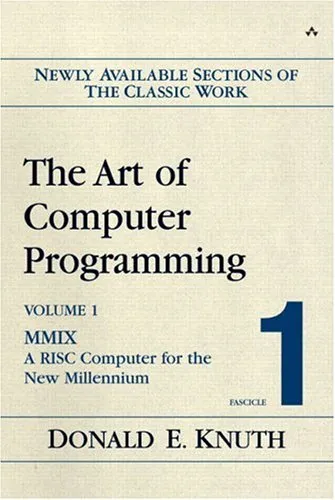
Welcome to the world of modern computer engineering and architecture with "The Art of Computer Programming, Volume 1, Fascicle 1: MMIX -- A RISC Computer for the New Millennium," an immersive exploration into the RISC architecture and its implementation, envisioned by the pro
Before you read
Welcome to the world of modern computer engineering and architecture with "The Art of Computer Programming, Volume 1, Fascicle 1: MMIX -- A RISC Computer for the New Millennium," an immersive exploration into the RISC architecture and its implementation, envisioned by the prolific Donald E. Knuth. This book is a testament to the evolution of computational hardware and the perpetual innovation that defines computer science.
The fascicle introduces readers to MMIX, a hypothetical computer that exemplifies the RISC (Reduced Instruction Set Computer) architecture. MMIX is designed to bridge the educational experiences of students and the practical challenges faced by contemporary computer scientists and engineers. This theoretical framework is not merely an academic exercise but a crucial tool designed to aid in the understanding of machine-level processes and their applications to high-level programming languages. MMIX serves as a modern successor to the MIX computer outlined in the original editions of "The Art of Computer Programming."
Donald Knuth meticulously details the instruction sets, architectures, and underlying principles that govern modern computing systems. Within the pages of this compelling volume, readers will encounter a comprehensive guide to machine language programming, memory management, and overall system operation. Moreover, this book provides exercises that not only solidify understanding but also challenge readers to apply knowledge in the development of efficient computing solutions.
"Preoccupation with efficiency gives us a telltale clue to the nature of programming and software design: namely, that it involves the continual balancing of resources."
"The computer science revolution brought about a new worldview that focuses on the interactions between small and large systems, as well as the scalability challenges that result from increases in data size and complexity."
"The Art of Computer Programming, Volume 1, Fascicle 1: MMIX -- A RISC Computer for the New Millennium" is not just a technical manual; it’s a window into the intricacies of system architecture and design that remains unparalleled in its depth and utility. This book is critical for students, educators, and professionals who aspire to excel in fields related to computer science and engineering. It provides the foundational knowledge needed to innovate and push the boundaries of what is possible with computing technology.
The significance of this volume lies in its ability to distill complex concepts into comprehensible, actionable knowledge. MMIX's educational model equips readers with the tools to not only grasp the fundamentals of computing but also apply them in varied contexts. Readers gain a deep appreciation for the craftsmanship involved in programming and the artistry that exists within the algorithms themselves.
Persian Summary
Your question is answered in the context of this title and author. Each answer uses 2 points.
0 reviews, 4.4 average out of 5
Sign in to publish a review.
Ask a focused question and learn from the community.
Related references that continue this learning path.
Knuth,Donald Ervin
![Cover of Computer Organization and Design: The Hardware Software Interface [RISC-V Edition]](https://s3.refhub.ir/images/thumb/Computer_Organization_and_Design__The_Hardwar_6135.webp)
David A. Patterson,John L. Hennessy
![Cover of Computer Organization and Design - The Hardware Software Interface [RISC-V Edition] Solution Manual](https://s3.refhub.ir/images/thumb/Computer_Organization_and_Design_-_The_Hardwa_6136.webp)
David A. Patterson,John L. Hennessy
Donald Ervin Knuth