Book guide and evaluation
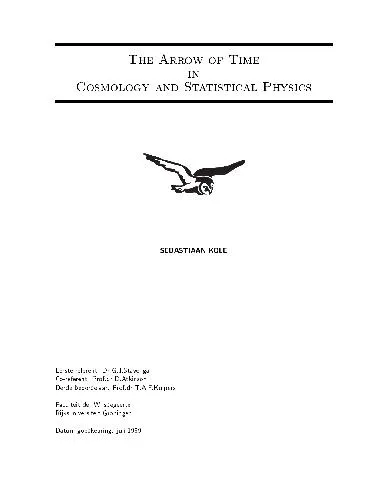
The arrow of time in cosmology and statistical physics
Kole S.
English
Beginner
Art
4.6 / 5
0 reviews
1999
Published
69
pages
491
views
Introduction Welcome to 'The Arrow of Time in Cosmology and Statistical Physics', a comprehensive exploration of one of the most intriguing concepts in both physics and philosophy. This book delves into the temporal asymmetry known as the "arrow of time", a quintessential feat
Before you read
What will you get from this book?
Introduction
Welcome to 'The Arrow of Time in Cosmology and Statistical Physics', a comprehensive exploration of one of the most intriguing concepts in both physics and philosophy. This book delves into the temporal asymmetry known as the "arrow of time", a quintessential feature that distinguishes the past from the future.
Detailed Summary of the Book
The intricate dance between cosmology and statistical physics forms the backbone of understanding time's unidirectional nature. In this book, we examine the profound implications of time's arrow, weaving through the vast expanse of the universe while anchoring in the microscopic intricacies of particles.
Beginning with foundational concepts, the book elucidates how the laws of thermodynamics, particularly the second law, play a pivotal role in defining time's arrow. With entropy's increase, we identify a natural progression from ordered to disordered states, offering a statistical explanation that resonates throughout cosmology. We further delve into the initial conditions of the universe - specifically, the low-entropy state of the early cosmos - and how this asymmetry provides the directionality of time.
As the narrative evolves, we navigate space-time's continuum, from the Big Bang to potential cosmological endpoints. The discussions integrate quantum mechanics and relativity, highlighting how these theories intertwine with time's arrow to shape cosmic evolution. Crucially, the book explores contrasting perspectives and contemplates the reversibility and irreversibility conundrum inherent in quantum processes.
Key Takeaways
- Understanding the concept of time's arrow is crucial for grasping fundamental physical theories and cosmology's broader narrative.
- The universe's observable time asymmetry is tied to entropy, linking microstates with macrostates in an expanding universe.
- Insights from statistical physics provide valuable tools to quantify and analyze how systems evolve, encapsulating the probabilistic nature of thermodynamic laws.
- Time's arrow opens discussions bridging physics with broader philosophical inquiries, challenging our perceptions of temporality and existence.
Famous Quotes from the Book
"Time does not pass, it accumulates - like a river defining its course not by the water flow but by the erosion it leaves behind."
"The universe is not a film played in one direction but a complex tapestry woven with threads of entropy and disorder."
Why This Book Matters
Time's arrow is not merely a subject of academic interest; it is a pivotal framework that underpins our experience of reality. This book bridges the gap between highly technical scientific discourse and the curious mind eager to explore the universe's temporal dimension.
'The Arrow of Time in Cosmology and Statistical Physics' stands out as a relevant text for anyone intrigued by the enigmas of time, from students and researchers to laypersons fascinated by the cosmos. By encapsulating complex theories into comprehensible narratives, the book invites readers to ponder profound questions about our existence, the universe's future, and the continuum of time and space.
Ask this book
Your question is answered in the context of this title and author. Each answer uses 2 points.
Sign in to ask the book assistant.
Reader reviews
0 reviews, 4.6 average out of 5
No reviews yet
If you have read this book, help the next reader with your experience.
Write a review
Sign in to publish a review.
Reader questions and answers
Ask a focused question and learn from the community.
Sign in to ask or answer a question.
No questions yet
Be the first to ask a clear, useful question.
What to read next
Related references that continue this learning path.
Modern Thermodynamics: From Heat Engines to Dissipative Structures
Dilip Kondepudi,I. Prigogine
1998
View book