Introduction
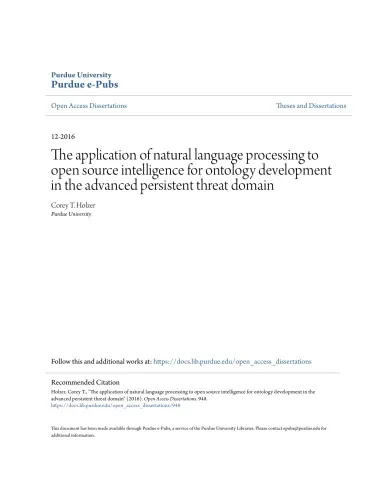
In the interconnected and ever-expanding realms of cybersecurity and data analysis, the need for innovative approaches to threat detection and prevention has never been more urgent. "The application of natural language processing to open source intelligence for ontology development in the advanced persistent threat domain" presents a cutting-edge exploration into combining natural language processing (NLP) with open source intelligence (OSINT) to enhance our understanding and defense against advanced persistent threats (APTs).
Detailed Summary of the Book
The book delves into the complex landscape of cybersecurity, where advanced persistent threats pose significant challenges to organizations and governments alike. APTs, being highly sophisticated cyberattacks, are often state-sponsored or carried out by organized groups with substantial resources. Traditional cybersecurity measures frequently fall short in anticipating or countering these threats due to their complex nature and the ever-evolving tactics, techniques, and procedures (TTPs) employed by cyber adversaries.
Here, NLP serves as a transformative technology for processing and analyzing large volumes of unstructured data available from OSINT sources. The book explores various NLP techniques and their applicability in extracting meaningful insights from textual data, which is pivotal in identifying potential threats and developing timely countermeasures. By proposing an ontology-based framework, this work facilitates the organization of knowledge pertaining to APTs, enabling cybersecurity professionals to synthesize information more efficiently and accurately.
Key Takeaways
- Integration of NLP and Cybersecurity: Understand how NLP can revolutionize the field of cybersecurity by offering new methodologies for data analysis and threat detection.
- APT Ontology Development: Gain insights into creating a structured knowledge base that captures the nuanced details of APT behavior, enhancing threat understanding and response strategies.
- Open Source Intelligence Utilization: Learn how to effectively leverage vast amounts of openly available data to predict, detect, and mitigate cyber threats.
- Cutting-edge Techniques Explained: Explore advanced NLP techniques, such as sentiment analysis, entity recognition, and language translation, tailored for cyber threat intelligence.
Famous Quotes from the Book
"In the battle against invisible foes, our greatest weapon often lies in deciphering the languages of the web."
"Minds working at the intersection of machine learning and cybersecurity are lighting the path to safer digital futures."
Why This Book Matters
Amidst an era where cybersecurity threats are both prevalent and perilous, the methodologies and frameworks proposed in this book provide a timely and much-needed resource for professionals and academics in the field. It offers an innovative perspective for those seeking to enhance security protocols through advanced technological applications. By addressing the intersections of NLP, OSINT, and cybersecurity, the book encourages a multidisciplinary approach to a problem of international concern.
Furthermore, the book equips cybersecurity professionals with the necessary tools and techniques to stay ahead of potential threats, urging a proactive rather than reactive stance in defense strategies. As cyber threats become more sophisticated, the knowledge embedded in the ontology of APTs becomes indispensable for safeguarding critical infrastructures and sensitive data worldwide.