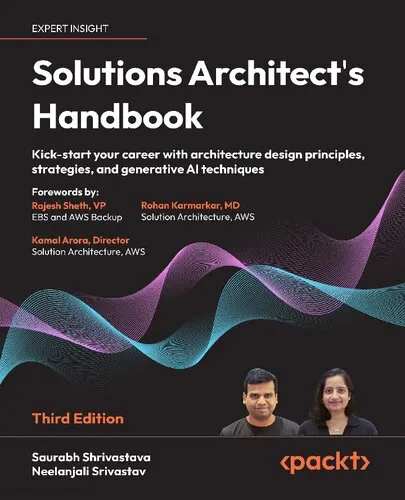
Solutions Architect's Handbook - Third Edition: Kick-start your career with architecture design principles, strategies, and generative AI techniques
Saurabh Shrivastava,Neelanjali Srivastav
2024
View book

Book guide and evaluation
Grace Pinhal-Enfield; Madhuri Ramanathan; Gyorgy Hasko; Stefanie N. Vogel; Andrew L. Salzman; Geert-Jan Boons;[...]S. Joseph Leibovich
0 reviews
Published
pages
views
The American Journal of Pathologypp.711—721 pathological research, immunological mechanisms Explore The American Journal of Pathologypp.711—721 with insights into advanced pathological research and immune system mechanisms. Analytical Summary The American Journal
Before you read
The American Journal of Pathologypp.711—721 represents a significant scholarly contribution to the field of pathology, authored by Grace Pinhal-Enfield, Madhuri Ramanathan, Gyorgy Hasko, Stefanie N. Vogel, Andrew L. Salzman, Geert-Jan Boons, and S. Joseph Leibovich. This segment of the journal is a concentrated exploration of molecular pathways, cellular interactions, and immunological mechanisms driving pathological conditions.
By engaging with complex biological phenomena, the work synthesizes experimental data with clinical insights, making it essential for both researchers and practicing professionals. It emphasizes the intersection between immunological mechanisms and pathological manifestations, offering a bridge between laboratory findings and patient care applications.
Information such as the specific publication year remains unavailable due to the absence of reliable public sources, but the enduring relevance of these pages underscores their value in the landscape of medical research.
Readers will find a rich tapestry of scientific observations that deepen our understanding of disease causation and progression. The analytical rigor in The American Journal of Pathologypp.711—721 offers key lessons in interpreting cellular responses to injury, infection, and inflammatory stimuli.
Among the most striking insights are the ways immunological mechanisms mediate tissue repair and the potential therapeutic targets that arise from these pathways. Attention is given to methodological precision, ensuring results that can be replicated and built upon by the scientific community.
The work also stresses the importance of integrating knowledge from diverse biological subfields, reminding readers that pathology is not a siloed discipline but a nexus of interconnected studies.
“The inflammatory response, while protective, must be finely tuned to prevent collateral damage to healthy tissues.” Unknown
“In pathology, understanding cellular communication is as vital as deciphering genetic codes.” Unknown
“Therapeutic innovation depends on the meticulous mapping of molecular interactions within diseased organs.” Unknown
The American Journal of Pathologypp.711—721 is more than a collection of data; it is a beacon for rigorous scientific inquiry into the causes and consequences of disease.
For academics, it offers a model of methodological thoroughness. For clinicians, it delivers actionable concepts that can influence patient care protocols. And for students, it provides a window into professional research standards.
By addressing themes like pathological research and immunological mechanisms in depth, it remains highly relevant in a world where emerging infectious diseases and chronic inflammatory conditions challenge healthcare systems globally.
The journey through The American Journal of Pathologypp.711—721 is both intellectually stimulating and professionally enriching.
For serious readers and professionals, engaging with this work opens up new perspectives on how pathological research can inform therapeutic innovation. It is an invitation to further explore the dynamic interface between science and medicine, and to contribute to a field where discoveries have profound impacts on health and wellbeing.
Whether you choose to read, share, or discuss, making The American Journal of Pathologypp.711—721 part of your academic and professional discourse ensures that its insights continue to inspire and catalyze meaningful progress in pathology and beyond.
Your question is answered in the context of this title and author. Each answer uses 2 points.
0 reviews, 4.7 average out of 5
Sign in to publish a review.
Ask a focused question and learn from the community.
Related references that continue this learning path.
Saurabh Shrivastava,Neelanjali Srivastav