

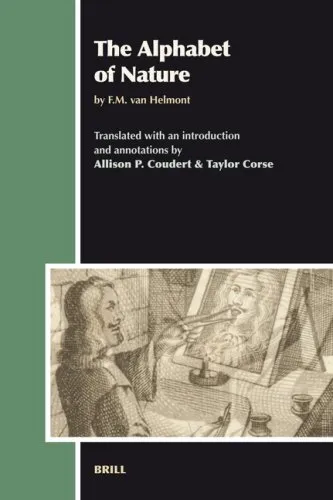
Book guide and evaluation
The Alphabet of Nature: By F.M. Van Helmont
Allison P. Coudert,Taylor Corse
English
Beginner
Historical
4.0 / 5
0 reviews
2007
Published
264
pages
585
views
Introduction to "The Alphabet of Nature: By F.M. Van Helmont" "The Alphabet of Nature" by Franciscus Mercurius van Helmont is a thought-provoking and innovative work that delves into the intersections of language, philosophy, nature, and divine knowledge. Written during
Before you read
What will you get from this book?
Introduction to "The Alphabet of Nature: By F.M. Van Helmont"
"The Alphabet of Nature" by Franciscus Mercurius van Helmont is a thought-provoking and innovative work that delves into the intersections of language, philosophy, nature, and divine knowledge. Written during the 17th century, this book encapsulates the author's mystical philosophy and his quest for uncovering the original, universal language believed to exist before the Tower of Babel. Van Helmont, influenced by both his father (the famed alchemist Johan Baptista van Helmont) and his extensive studies across disciplines like theology, linguistics, and Kabbalah, presents an extraordinary intellectual adventure that challenges traditional notions of language and human comprehension.
This book stands as a testament to the idea that language, far from being a mere instrument of communication, is a divine gift deeply embedded in the natural order. Van Helmont uses a blend of scientific inquiry, mystical insight, and philosophical reasoning to argue for the existence of a primal, perfect language—the divine alphabet that holds the power to unveil the mysteries of creation itself. "The Alphabet of Nature" invites readers into Van Helmont’s world where words become a bridge between humanity and transcendence, urging them to contemplate language as more than an earthly construct.
Summary of the Book
The book is divided into distinct sections where Van Helmont develops his thesis on the divine nature of language. He begins by exploring the origins of human speech, attributing its fragmentation to the biblical story of the Tower of Babel. According to Van Helmont, the confusion of tongues that followed the tower's destruction marked the loss of humanity's connection to a universal language. He posits that reclaiming this original language could lead to unparalleled enlightenment and a deeper understanding of God's creation.
Van Helmont traces his ideas through Hebrew, which he regards as the closest remnant of the original divine language. He studies its alphabet intensively, believing that the shapes and sounds of Hebrew letters carry inherent metaphysical power. Departing from a strictly linguistic exploration, Van Helmont integrates elements of mysticism and philosophy, suggesting that by deciphering this divine alphabet, one could unlock humanity's latent potential and reconnect with lost knowledge.
The book also critiques the limitations of then-contemporary languages, emphasizing their inability to fully express divine truths. Van Helmont argues for the restoration of unity in language, highlighting the potential of such a linguistic renaissance to revolutionize theology, science, and culture.
Key Takeaways
- Language is both divine and natural, representing humanity’s connection to the spiritual realm.
- The fragmentation of languages through history has contributed to humanity's separation from universal truth.
- Hebrew, as a divine alphabet, holds clues to uncovering the lost universal language.
- Language has the potential to transform human understanding of science, theology, and nature when approached in its original, divine state.
Famous Quotes from the Book
"The Word was not merely a sound, but a living vessel containing the spirit of man and the likeness of God."
"To understand nature is to understand God's language, spoken before the division of nations."
Why This Book Matters
"The Alphabet of Nature" is significant not only within the context of early modern intellectual history but also as a timeless exploration of human communication and cognition. Its radical ideas about the divine origins of language have influenced scholars of linguistics, theology, and mysticism for centuries. By combining rigorous research with esoteric thought, Van Helmont provides a framework for reimagining the interplay between language and reality.
In a world increasingly divided by linguistic and cultural boundaries, Van Helmont’s vision of a unified, divine language resonates strongly. His call to rediscover the sacred dimensions of speech and writing continues to inspire philosophers, linguists, and spiritual seekers who yearn for a deeper connection with the natural and divine order. This book is not only an important historical text but also a profound philosophical work, reminding readers of the enduring mysteries and transformative power of language.
Ask this book
Your question is answered in the context of this title and author. Each answer uses 2 points.
Sign in to ask the book assistant.
Reader reviews
0 reviews, 4.0 average out of 5
No reviews yet
If you have read this book, help the next reader with your experience.
Write a review
Sign in to publish a review.
Reader questions and answers
Ask a focused question and learn from the community.
Sign in to ask or answer a question.
No questions yet
Be the first to ask a clear, useful question.
What to read next
Related references that continue this learning path.


Carl Friedrich Gauss: Titan of Science
G. Waldo Dunnington,Jeremy Gray,Fritz-Egbert Dohse
2004
View book