In Search of Excellence: Lessons from America's Best-Run Companies
Thomas J. Peters,Robert H.,Jr. Waterman
2006
View book
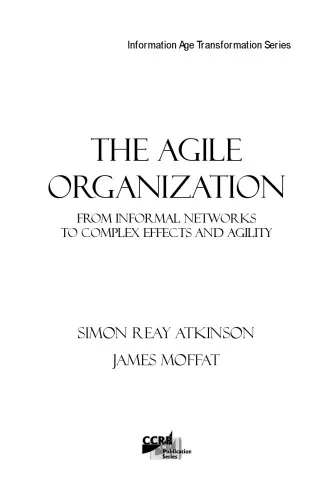
Book guide and evaluation
Simon Reay Atkinson,James Moffat
0 reviews
Published
pages
views
Introduction to 'The Agile Organization: From Informal Networks to Complex Effects and Agility' In a world where the pace of change is relentless and unforgiving, organizations must develop the capacity to adapt dynamically and swiftly. "The Agile Organization: From Inform
Before you read
In a world where the pace of change is relentless and unforgiving, organizations must develop the capacity to adapt dynamically and swiftly. "The Agile Organization: From Informal Networks to Complex Effects and Agility" delves into the heart of what makes organizations resilient and adaptable. Authored by Simon Reay Atkinson and James Moffat, this book is an essential guide for leaders and managers seeking to transform their organizations into agile entities equipped for the complexities of the Information Age.
The book embarks on exploring the pivotal role of informal networks within organizations. Atkinson and Moffat illustrate how these networks, often invisible and unacknowledged, are the lifeblood of organizational knowledge and innovation. By engaging with these informal structures, organizations can better harness their innate potential to respond to external volatilities.
Through a series of thought-provoking discussions, the authors dissect the multi-dimensional concept of agility. They introduce the idea of 'complex effects'—the unpredictable and emergent outcomes that arise from the interplay of numerous variables in an organizational system. By drawing parallels between emergent behaviors in complex systems and organizational contexts, the book offers a novel perspective on agility.
The narrative progresses by examining practical aspects of fostering agility within an organization. Atkinson and Moffat integrate theories from complexity science and network theory to present strategies for leaders to recognize and leverage these informal networks. By implementing the recommendations from the book, leaders are more likely to create a resilient and responsive organizational culture capable of enduring unforeseen challenges.
“True agility stems from the seamless interplay between structured processes and informal networks.”
“Complex effects are the emergent properties that define an agile and resilient organization.”
"The Agile Organization" offers a comprehensive toolkit for understanding and implementing agility in complex environments. In an era dominated by rapid technological advancements and global shifts, this book addresses the urgent need for businesses to rethink traditional operational paradigms. It underscores the importance of agility—not as trend jargon, but as a foundational element of competitive advantage and long-term sustainability.
The insights drawn from the interdisciplinary approaches advocated by Atkinson and Moffat shed light on how organizations can navigate uncertainty. By embracing the unpredictable nature of complex systems, managers and leaders can better position their organizations to not only survive but thrive amidst change.
Ultimately, "The Agile Organization" is a beacon for those willing to embrace the transformative power of agility. It is not merely a guide but a call to action for cultivating organizations that are smarter, faster, and more responsive than ever before.
Your question is answered in the context of this title and author. Each answer uses 2 points.
0 reviews, 4.7 average out of 5
Sign in to publish a review.
Ask a focused question and learn from the community.
Related references that continue this learning path.
Thomas J. Peters,Robert H.,Jr. Waterman
Peter F. Drucker,Rick Wartzman