
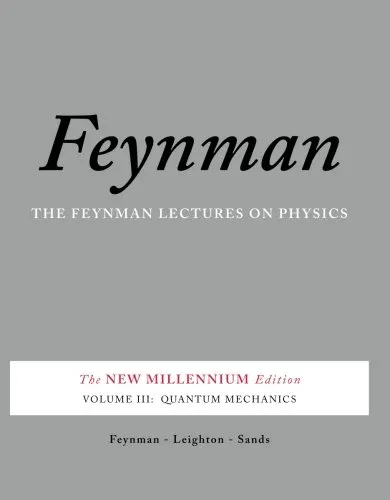
The Feynman Lectures on Physics, Vol. III: The New Millennium Edition: Quantum Mechanics
Richard P. Feynman,Robert B. Leighton,Matthew Sands
2011
View book
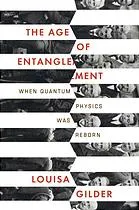
Book guide and evaluation
Gilder,Louisa
0 reviews
Published
pages
views
Introduction to "The Age of Entanglement: When Quantum Physics Was Reborn" "The Age of Entanglement: When Quantum Physics Was Reborn" is an enthralling journey through the history of quantum physics, skillfully written to bring a complex and revolutionary scientific field
Before you read
"The Age of Entanglement: When Quantum Physics Was Reborn" is an enthralling journey through the history of quantum physics, skillfully written to bring a complex and revolutionary scientific field to life. Authored by Louisa Gilder, this book delves into the notion of quantum entanglement—a concept that baffled and intrigued some of the greatest minds of the 20th century. It masterfully weaves history, science, and human drama into a compelling narrative that engages both experts and curious readers alike. Gilder showcases how thought experiments, personal correspondence, and groundbreaking discoveries contributed to our current understanding of the quantum world.
With its unique blend of historical retellings and lively dialogue, the book provides a fresh perspective on the history of quantum mechanics. It invites readers to witness the debates, triumphs, and existential puzzles that defined the story of quantum entanglement, making it clear why this topic remains at the heart of modern physics. Below, we’ll explore a detailed summary of the book, share key takeaways, uncover some unforgettable quotes, and reflect on why this fascinating book matters.
"The Age of Entanglement" is divided into chapters that guide the reader through decades of intellectual exploration. Starting with the early 20th century, it sets the stage by describing the initial development of quantum mechanics, a branch of physics that shatters our classical understanding of the universe. At the center of this narrative is quantum entanglement—a bizarre phenomenon predicted by quantum theory in which the properties of particles become interconnected, regardless of the distance separating them.
Louisa Gilder brings this dense subject to life by imaginatively reconstructing dialogues between legendary scientists, such as Albert Einstein, Niels Bohr, Erwin Schrödinger, and John Bell. The book takes readers to pivotal moments in history, including the 1935 Einstein-Podolsky-Rosen (EPR) paper which questioned the completeness of quantum mechanics, and Schrödinger’s introduction of the term "entanglement." Gilder also gives prominence to lesser-known yet profoundly important physicists like David Bohm and Claude Shannon, who helped shape the conversation around quantum theory and its implications.
As the story progresses, we move from theoretical quandaries to experimental breakthroughs. The book explores how pivotal experiments in the late 20th century, such as those conducted by Alain Aspect, validated the spooky reality of entanglement. It also delves deeply into the philosophical dimensions of quantum physics, from questions of locality and determinism to its implications for our understanding of reality itself. Through vivid storytelling and accessible explanations, Gilder makes it possible for readers to appreciate not just the science, but the human struggle and collaboration that fueled quantum advancements.
"Entanglement is not one, but rather the characteristic trait of quantum mechanics—the one that enforces its entire departure from classical lines of thought." — Erwin Schrödinger
"God does not play dice with the universe." — Albert Einstein
"The reality that quantum theory describes is not one that we humans are intuitively equipped to understand—it is, as Bohr said, 'un-humanizable'." — Louisa Gilder
"The Age of Entanglement" isn’t just a book about physics; it’s a book about the process of discovery and the evolution of human thought. It captures the revolutionary spirit of quantum mechanics while making it relatable to a wide audience. Gilder crucially emphasizes that science is a human and historical endeavor, not just a collection of cold, hard facts. This makes the book meaningful to anyone with an interest in how ideas shape the way we perceive the world.
At a time when quantum technologies are rapidly advancing, understanding the history of quantum physics and the concept of entanglement is more important than ever. Gilder’s approach cultivates awe and curiosity, inspiring readers to think beyond the confines of classical reasoning. By blending science, history, and philosophy, "The Age of Entanglement" ensures its place as a touchstone for both laypeople and experts who wish to explore the layers of quantum reality.
Your question is answered in the context of this title and author. Each answer uses 2 points.
0 reviews, 4.4 average out of 5
Sign in to publish a review.
Ask a focused question and learn from the community.
Related references that continue this learning path.
Richard P. Feynman,Robert B. Leighton,Matthew Sands
Anthony Duncan;Michel Janssen