
Conflict and Compromise: The Strategy, Politics and Diplomacy of the French Blockade, 1914–1918
Marjorie Milbank Farrar (auth.)
1974
View book
Book guide and evaluation
J. Lemke Profes
0 reviews
Published
pages
views
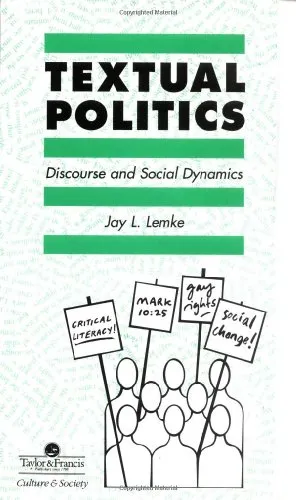
Introduction to "Textual Politics: Discourse and Social Dynamics" "Textual Politics: Discourse and Social Dynamics" examines the intricate relationship between language, power, and social orders. Written with a critical lens on how texts and discourses shape social realiti
Before you read
"Textual Politics: Discourse and Social Dynamics" examines the intricate relationship between language, power, and social orders. Written with a critical lens on how texts and discourses shape social realities, this book dives into the intersection of literacy practices, education, and socio-political transformation. As part of the Critical Perspectives on Literacy and Education series, it provides readers with the tools to analyze how texts are embedded in systems of power and how they perpetuate or destabilize these systems. The book is deeply rooted in socio-cultural theory, offering a practical perspective for educators, researchers, and activists who seek to understand the political nature of discourse and literacy.
At its core, "Textual Politics" explores how discourse not only reflects but also actively shapes social dynamics and structures. Language is never neutral—it is laden with intentions, ideologies, and implications for both individuals and communities. This text provides a framework for understanding the dynamics of "textual politics," where texts serve as mechanisms of power, status quo reinforcement, and potential sites for resistance.
The book is structured to guide readers from theoretical foundations to practical applications. Early chapters define discourse and its role in constructing meaning in social contexts. Readers are introduced to the concept of intertextuality and how texts are situated within broader systems of communication. By analyzing real-world examples—from classroom interactions to mass media communications—Lemke demonstrates how language policies, educational curricula, and public discourses all contribute to maintaining or challenging institutional power.
One of the book’s significant contributions is its examination of literacy education. Lemke critiques traditional approaches that treat literacy as a set of decontextualized skills. Instead, he presents literacy as a socially situated practice intertwined with cultural norms and power relations. Drawing on case studies, the book illustrates that teaching students to critically analyze discourse empowers them to navigate complex social systems, challenge hegemonic narratives, and become agents of change.
"Texts are never neutral; they embody ideologies, sustain social structures, and carry the weight of historical power struggles."
"To comprehend a text is to see its connections—not just to other texts, but to the social world in which it lives."
"Literacy is far more than the ability to read and write; it is the capacity to interpret and intervene in the world."
"Textual Politics" serves as an essential guide for anyone seeking to understand the critical role of language in society. In an era marked by misinformation, media manipulation, and increasing inequality, the power of discourse feels more significant than ever. The book equips educators, researchers, and activists with a robust framework for analyzing and challenging the narratives that sustain social injustices.
Furthermore, the book’s focus on education highlights its relevance in empowering future generations. By rethinking traditional approaches to literacy and teaching students to critically engage with texts, this work fosters a deeper understanding of the role of communication in social transformation. Through practical examples and theoretical insights, Lemke encourages readers to rethink their relationship with language and to harness its transformative potential for creating more equitable societies.
Ultimately, "Textual Politics" offers both a critique of existing systems and a hopeful call to action. It reminds us that through critical dialogue, analysis, and education, society has the tools to resist injustice and build a more inclusive future.
Your question is answered in the context of this title and author. Each answer uses 2 points.
0 reviews, 4.5 average out of 5
Sign in to publish a review.
Ask a focused question and learn from the community.
Related references that continue this learning path.
Marjorie Milbank Farrar (auth.)
Friedel Bolle,Marco Lehmann-Waffenschmidt (auth.),Professor Dr. Friedel Bolle,Professor Dr. Marco Lehmann-Waffenschmidt (eds.)