
Our Brave New World: Essays on the Impact of September 11 (Hoover Institution Press Publication)
WLADYSLAW PLESZCZYNSKI
2002
View book
Book guide and evaluation
Hsinchun Chen,Edna Reid,Joshua Sinai,Andrew Silke,Boaz Ganor
0 reviews
Published
pages
views
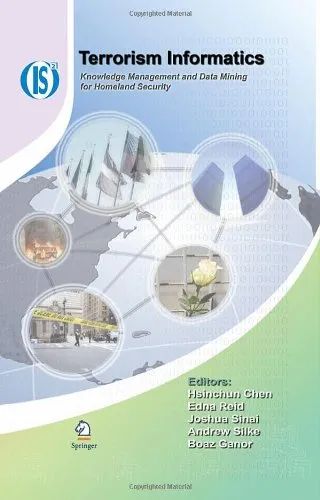
Terrorism Informatics: Knowledge Management and Data Mining for Homeland Security Homeland security intelligence, counter-terrorism data analysis Explore Terrorism Informatics: Knowledge Management and Data Mining for Homeland Security, a definitive guide to modern coun
Before you read
The book Terrorism Informatics: Knowledge Management and Data Mining for Homeland Security is an authoritative reference that bridges the gap between theoretical frameworks and practical applications in the field of counter-terrorism. Authored by Hsinchun Chen, Edna Reid, Joshua Sinai, Andrew Silke, and Boaz Ganor, it provides a comprehensive exploration of how data-driven analytics, knowledge management systems, and informatics methodologies can be leveraged to enhance homeland security operations.
This work delves into the multidisciplinary nature of terrorism informatics, where computer science, information management, social sciences, and intelligence analysis intersect. Its chapters offer rigorous analyses of methods such as data mining, text analysis, and link analysis, alongside the real-world challenges of implementing these technologies within diverse political and operational contexts.
The publication year is noted as “Information unavailable” due to the lack of reliable public sources confirming the exact date in this format request. Nonetheless, the material remains highly relevant, offering methodological clarity for academics, law enforcement, military strategists, and policy makers.
Readers gain not only conceptual insight but operational strategies from this book. It emphasizes the intelligent integration of technology with human expertise to thwart terrorist activities.
Key points include the importance of advanced analytics in identifying threats, the role of collaborative intelligence networks, and the ethical considerations in counter-terrorism informatics.
Another takeaway is the necessity for adaptive systems that can process vast, heterogeneous datasets efficiently without compromising privacy or civil liberties. This sensitivity to balance reinforces the book’s value for both decision-makers and technical professionals in homeland security intelligence.
Effective counter-terrorism begins with timely, precise, and well-structured information.Unknown
Data mining, when guided ethically, empowers security agencies to outpace emerging threats.Unknown
Homeland security intelligence thrives at the intersection of human insight and computational power.Unknown
In an era where terrorism evolves rapidly in scope and sophistication, Terrorism Informatics: Knowledge Management and Data Mining for Homeland Security equips stakeholders with actionable knowledge.
Its authoritative approach makes it an important educational resource for universities offering courses in counter-terrorism, criminology, and data science. Simultaneously, practitioners in intelligence and security agencies can apply its concepts to real-world scenarios—ranging from threat detection to preventative strategy design.
By combining homeland security intelligence with state-of-the-art analytical tools, the book underscores a future-ready vision for defending against asymmetric threats while respecting democratic values.
For serious readers, academics, and frontline security professionals alike, Terrorism Informatics: Knowledge Management and Data Mining for Homeland Security serves as more than a textbook—it is a roadmap for informed, ethical, and effective action.
Engaging with its contents fosters a deeper understanding of how homeland security intelligence can be enhanced through the strategic use of informatics and collaborative structures. In doing so, it invites readers into a multidisciplinary conversation spanning technology, policy, and ethics.
The next step is clear: read, share, and discuss the book's insights within your professional circles, academic forums, and policy groups, ensuring that the knowledge it provides becomes a catalyst for innovation and resilience in counter-terrorism efforts.
Your question is answered in the context of this title and author. Each answer uses 2 points.
0 reviews, 4.7 average out of 5
Sign in to publish a review.
Ask a focused question and learn from the community.
Related references that continue this learning path.
WLADYSLAW PLESZCZYNSKI