

Book guide and evaluation
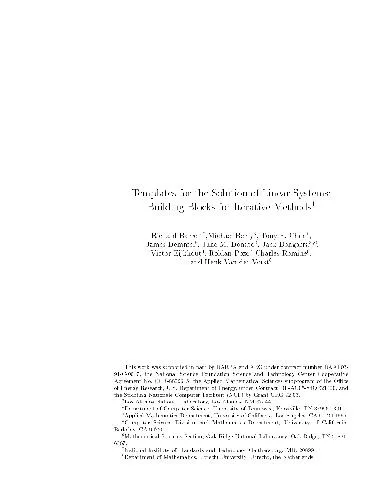
Templates for the solution of linear systems.Building blocks for iterative methods
Barrett R.
English
Beginner
Mathematics
4.7 / 5
0 reviews
-
Published
141
pages
129
views
Introduction to 'Templates for the Solution of Linear Systems: Building Blocks for Iterative Methods' Welcome to the world of linear algebra and computational mathematics with one of the most quintessential resources for solving linear systems: 'Templates for the Solution of L
Before you read
What will you get from this book?
Introduction to 'Templates for the Solution of Linear Systems: Building Blocks for Iterative Methods'
Welcome to the world of linear algebra and computational mathematics with one of the most quintessential resources for solving linear systems: 'Templates for the Solution of Linear Systems: Building Blocks for Iterative Methods'. This book serves as both a guide and a reference manual, offering practical templates and structured building blocks that simplify the development and application of iterative methods for solving linear equations.
The book is tailored for computational scientists, applied mathematicians, and engineers who require efficient, reliable techniques to address large-scale linear systems. By presenting a collection of iterative algorithms alongside their properties, usage contexts, and practical implementation advice, this resource bridges the gap between theoretical concepts and real-world problem-solving. Whether you're analyzing sparse matrices or designing software for linear solvers, this book provides invaluable insights into modern computational techniques.
Detailed Summary of the Book
The core goal of the book is to offer an accessible, modular framework for understanding iterative methods, which are essential for solving large, sparse linear systems. With a focus on practicality, the book avoids unnecessary complexity while providing rigorous explanations of foundational methods.
The content is organized around templates—generalized frameworks or "recipes"—for implementing iterative solvers. Each template is explained step by step, with discussions on convergence properties, preconditioning techniques, computational considerations, and applications. The authors emphasize adaptability, enabling readers to tailor the templates to their specific problems and computational environments.
Topics covered in the book include:
- Conjugate Gradient (CG) and its variants for symmetric positive definite matrices.
- Generalized minimal residual methods such as GMRES for non-symmetric linear systems.
- Bi-Conjugate Gradient (BiCG), BiCGSTAB, and other methods for non-Hermitian systems.
- Preconditioning strategies to improve the efficiency of iterative solvers.
- Practical guidelines for choosing the right method based on matrix properties.
The book also addresses performance considerations such as memory usage, computational cost, and parallelization opportunities, making it highly relevant for modern applications in computational science and numerical analysis.
Key Takeaways
Through this book, readers gain both theoretical and practical tools for tackling linear systems efficiently. Here are some key takeaways:
- Learn the foundations of iterative methods and their role in modern computational mathematics.
- Understand the core principles of popular methods like CG, GMRES, and BiCGSTAB.
- Develop the ability to implement and customize iterative solvers for diverse applications.
- Gain insights into preconditioning, improving convergence rates, and optimizing performance.
- Enhance problem-solving skills by identifying the most appropriate solver based on problem characteristics.
Famous Quotes from the Book
Here are some notable quotes that capture the essence of the book:
"Iterative methods do not merely calculate a solution—they embody a process of refinement where understanding evolves with each successive approximation."
"The choice of the 'right method' depends not just on the geometry of the system but also on the geometry of the problem itself."
"Templates act as guides, not prescriptions. They reveal the structure behind the method, inviting adaptation and innovation."
Why This Book Matters
'Templates for the Solution of Linear Systems' fills a critical gap in the landscape of computational mathematics and numerical analysis literature. While many texts focus on the theory of iterative methods, this book emphasizes practical implementation and adaptability, making it an essential resource for professionals and students alike.
Iterative methods are cornerstones of modern computational science, particularly in fields where solving large-scale linear systems is routine. However, the vast diversity of methods and the complexity of their implementations often present significant barriers to entry. This book demystifies these challenges by presenting clear, modular templates that are ready to be used and customized.
Furthermore, the authors meticulously address common pitfalls and challenges, making this book a trusted guide for both beginners and seasoned practitioners. If you're looking to build expertise in computational methods or empower your workflows with optimized linear solvers, this book is an indispensable addition to your library.
Ask this book
Your question is answered in the context of this title and author. Each answer uses 2 points.
Sign in to ask the book assistant.
Reader reviews
0 reviews, 4.7 average out of 5
No reviews yet
If you have read this book, help the next reader with your experience.
Write a review
Sign in to publish a review.
Reader questions and answers
Ask a focused question and learn from the community.
Sign in to ask or answer a question.
No questions yet
Be the first to ask a clear, useful question.
What to read next
Related references that continue this learning path.


Modern Computer Vision with PyTorch: A Practical Roadmap From Deep Learning Fundamentals to Advanced Applications and Generative AI, 2nd Edition
V Kishore Ayyadevara,Yeshwanth Reddy
2023
View book