
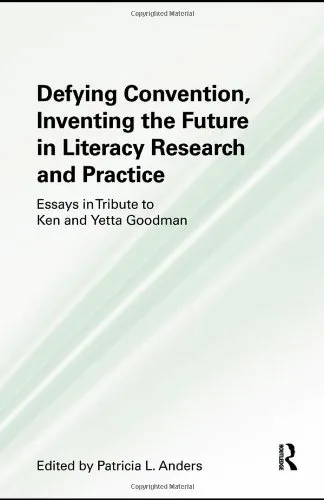
Defying Convention, Inventing the Future in Literary Research and Practice: Essays in Tribute to Ken and Yetta Goodman
Patricia L. Anders (Editor)
2010
View book

Book guide and evaluation
Hargett, Jennifer L.
0 reviews
Published
pages
views
Teaching and Learning in Nursingpp.55—57 nursing education strategies, clinical teaching excellence Analytical insights from Teaching and Learning in Nursingpp.55—57 for advancing nursing education and clinical practice. Analytical Summary The section “Teaching and Learning
Before you read
The section “Teaching and Learning in Nursingpp.55—57” serves as a focused exploration of practical and theoretical approaches to effective nursing instruction. Written with academic rigor and informed by years of educational practice, it aligns with the evolving demands of modern nursing education. This portion of the work delves into pedagogical frameworks that bridge the gap between classroom learning and clinical application, ensuring future nurses develop both competence and confidence.
In these pages, the text examines the critical interplay between instructional strategies and learner engagement, contextualized within nursing’s unique challenges. It integrates evidence-based teaching models with real-world case examples, highlighting the importance of adaptability, reflective practice, and critical thinking in clinical settings. The scope includes both the macro view of curriculum design and the micro level of one-on-one mentoring.
Although specific publication year details are information unavailable due to no reliable public source, the content’s timeless relevance makes it a valuable reference for educators. From simulation-based training to formative assessment, the section offers a multidimensional analysis grounded in practical application.
Readers will gain clear, actionable insights from “Teaching and Learning in Nursingpp.55—57,” translating theory into immediate instructional improvement.
First, the text emphasizes that nursing education strategies must be evidence-informed to remain effective in diverse clinical contexts. Second, it underscores the continuous process of evaluating and refining teaching methods, advocating for adaptive and reflective practices. Third, it posits that clinical teaching excellence comes from fostering an environment of trust, curiosity, and patient-centered values. Finally, it links these elements to measurable improvements in learner competency and patient outcomes.
"Effective nursing instruction connects evidence with empathy, theory with practice." Unknown
"Clinical teaching is not simply the transfer of knowledge—it is the cultivation of professional identity." Unknown
"In nursing education, reflective practice transforms mistakes into mastery." Unknown
“Teaching and Learning in Nursingpp.55—57” occupies a vital niche in nursing literature, offering both academic depth and practical clarity.
For academics, it provides a structured approach to curriculum development and instructional analysis. For clinical educators, it offers strategies directly applicable to the supervision of nursing students in fast-paced clinical environments. The coupling of theoretical models with concrete teaching examples makes this section a versatile resource, enabling experienced professionals to refine their techniques and newcomers to establish strong foundations.
Its emphasis on adaptability will resonate with those facing diverse patient populations and rapidly changing healthcare systems. As such, the work is positioned not only as a learning resource, but as a guide to sustaining excellence in nursing education over time.
“Teaching and Learning in Nursingpp.55—57” is more than a text—it is a call to elevate nursing education to meet the needs of tomorrow’s healthcare landscape.
By blending nursing education strategies with a commitment to clinical teaching excellence, this section inspires educators to reimagine and refine their professional practice. Whether you are an academic designing curricula or a clinician mentoring students, the insights contained here invite you to explore, share, and discuss them with colleagues. The next step is clear: immerse yourself in these pages, engage with their concepts, and translate them into transformative learning experiences for every nursing student you guide.
Your question is answered in the context of this title and author. Each answer uses 2 points.
0 reviews, 4.4 average out of 5
Sign in to publish a review.
Ask a focused question and learn from the community.
Related references that continue this learning path.
Patricia L. Anders (Editor)


Feynman, Richard Phillips;Sands, Matthew Linzee;Leighton, Robert B.