
Book guide and evaluation
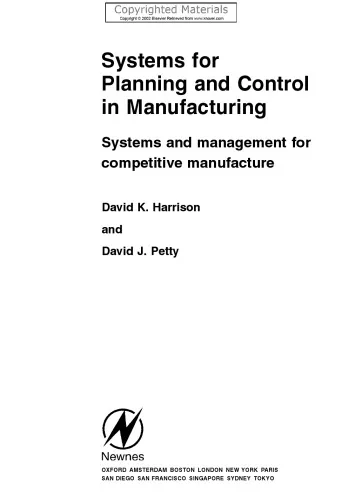
Systems for Planning and Control in Manufacturing (IIE Core Textbooks Series)
D. K. Harrison D. J. Petty
English
Beginner
Economics
4.6 / 5
0 reviews
2002
Published
311
pages
215
views
Introduction to "Systems for Planning and Control in Manufacturing" "Systems for Planning and Control in Manufacturing," part of the widely acclaimed IIE Core Textbooks Series, is an authoritative resource designed to educate and empower professionals, students, an
Before you read
What will you get from this book?
Introduction to "Systems for Planning and Control in Manufacturing"
"Systems for Planning and Control in Manufacturing," part of the widely acclaimed IIE Core Textbooks Series, is an authoritative resource designed to educate and empower professionals, students, and enthusiasts in the field of manufacturing. Written by D. K. Harrison and D. J. Petty, the book explores the intricate systems and methodologies required for efficient production planning, process optimization, and manufacturing control. With a focus on both foundational theories and practical applications, this book provides a comprehensive understanding of manufacturing systems.
In a rapidly evolving industrial environment, the importance of robust planning and control systems cannot be overstated. From ensuring that production schedules align with demand forecasts to effectively managing materials, labor, and machines, these systems serve as the backbone of any successful manufacturing operation. The book combines established practices with modern technological advancements, providing a timeless reference for readers across industries. Whether you are an engineer, manager, or academic, this book equips you with the tools to innovate, improve efficiency, and drive results.
Detailed Summary of the Book
The book is divided into carefully structured chapters that guide readers through every aspect of manufacturing planning and control. It begins with an overview of manufacturing systems, offering insights into their historical evolution and future trends. The early chapters delve into key foundational concepts, such as production planning, scheduling, capacity management, inventory control, and resource allocation.
A significant focus is placed on modern manufacturing techniques, including Just-in-Time (JIT), Lean Manufacturing, and Material Requirements Planning (MRP). The text explains how these methodologies contribute to waste reduction, improved efficiency, and enhanced adaptability in a fluctuating market. The authors also emphasize the critical role of technology, such as Enterprise Resource Planning (ERP) systems and automation tools, in streamlining processes and fostering data-driven decision-making.
Towards the later chapters, the book introduces advanced planning models, risk management strategies, and quality control measures. Real-world case studies and practical examples are interwoven throughout the text to demonstrate how manufacturing control systems are implemented in diverse industries. By balancing theory with practical application, the book ensures that readers gain both knowledge and actionable insights.
Key Takeaways
- Understand the core principles that drive effective production planning and material control.
- Learn how to implement Lean Manufacturing, JIT, MRP, and ERP systems efficiently.
- Appreciate the roles of flexibility and adaptability in modern manufacturing systems.
- Identify frameworks for inventory management and capacity planning in the face of uncertainty.
- Leverage technology and automation to enhance productivity and decision-making.
- Apply the knowledge to solve real-world manufacturing problems through case studies and strategic approaches.
Famous Quotes from the Book
"Manufacturing is more than machines and materials—it is a synchronized process driven by careful planning, precise control, and continuous improvement."
"Efficiency in production is not just about cutting costs; it is about creating value through a system that is both effective and sustainable."
"The secret to mastering manufacturing lies not in following past formulas but in embracing innovation and adaptation in the face of change."
Why This Book Matters
In a world of increasing competition and a drive for higher productivity, "Systems for Planning and Control in Manufacturing" stands out as a cornerstone of manufacturing education. Its relevance extends across industries, from automotive to aerospace, and its teachings resonate with individuals at all levels, from students studying supply chain management to seasoned executives leading global production teams.
The book's unique approach of blending theoretical frameworks with practical applications ensures that readers gain an actionable understanding of manufacturing processes. Moreover, it highlights the importance of embracing innovation and adaptability in facing challenges such as globalization, technological disruption, and environmental constraints.
By equipping readers with the knowledge to build efficient systems, the book directly contributes to the creation of more resilient and sustainable manufacturing infrastructures. Its impact extends beyond immediate operations, fostering a mindset of continuous improvement and excellence in the manufacturing sector.
For anyone who seeks to understand the mechanisms behind successful manufacturing practices, this book is an invaluable resource. It matters because it not only teaches but also inspires readers to rethink manufacturing as a sophisticated, adaptable, and human-driven process.
Ask this book
Your question is answered in the context of this title and author. Each answer uses 2 points.
Sign in to ask the book assistant.
Reader reviews
0 reviews, 4.6 average out of 5
No reviews yet
If you have read this book, help the next reader with your experience.
Write a review
Sign in to publish a review.
Reader questions and answers
Ask a focused question and learn from the community.
Sign in to ask or answer a question.
No questions yet
Be the first to ask a clear, useful question.
What to read next
Related references that continue this learning path.


Modern Computer Vision with PyTorch: A Practical Roadmap From Deep Learning Fundamentals to Advanced Applications and Generative AI, 2nd Edition
V Kishore Ayyadevara,Yeshwanth Reddy
2023
View book