

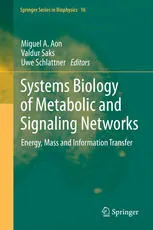
Book guide and evaluation
Systems Biology of Metabolic and Signaling Networks: Energy, Mass and Information Transfer
M. A. Aon,D. Lloyd,V. Saks (auth.),Miguel A. Aon,Valdur Saks,Uwe Schlattner (eds.)
English
Beginner
Physics
4.5 / 5
0 reviews
2014
Published
375
pages
176
views
Introduction The book Systems Biology of Metabolic and Signaling Networks: Energy, Mass and Information Transfer provides a groundbreaking exploration into the intricate interplay between metabolism and cellular signaling systems. Authored and edited by leading experts in the
Before you read
What will you get from this book?
Introduction
The book Systems Biology of Metabolic and Signaling Networks: Energy, Mass and Information Transfer provides a groundbreaking exploration into the intricate interplay between metabolism and cellular signaling systems. Authored and edited by leading experts in the field, this work serves as a template for understanding how cells regulate their energy, mass, and information to achieve homeostasis and respond to external stimuli. The authors bridge disciplines—ranging from molecular biology and biochemistry to systems biology and computational modeling—offering a holistic view of the fundamental nature of cellular and organismal life.
Given the growing complexity of biological data in modern research, this book is a timely and invaluable resource for researchers, educators, and students. By integrating metabolic networks with signaling pathways, the book emphasizes the need for a systems-level approach to understand cellular processes across various scales of organization. Supported by mathematical modeling and computational simulations, the text sheds light on dynamic cellular states such as energy transduction, signal integration, functional coupling, and metabolic regulation under physiological and pathological conditions.
Detailed Summary of the Book
This book is meticulously structured to guide readers through complex biochemical processes, coupling them with the principles of systems biology.
The narrative begins with foundational concepts of systems biology, focusing on the interactions between energy transduction, mass transfer, and signaling events. By analyzing these dimensions, the authors establish a framework to investigate cellular dynamics in both steady-state and transitional periods. Early chapters explore the structure and flexibility of energy networks within cells, providing a detailed analysis of the mitochondrial function and its regulatory mechanisms, highlighting the essential role mitochondria play as cellular energy hubs.
Advancing through the chapters, the focus shifts to signaling cascades that enable cells to adapt to stress, environmental changes, and energy demands. These sections delve into feedback mechanisms, molecular interactions, and emergent properties of networks that would be otherwise imperceptible without a systems biology perspective.
The book also includes various case studies involving pathological conditions such as neurodegeneration, cancer, and metabolic diseases, elucidating how disruptions in energy and signaling networks lead to disease states. These examples underscore the importance of understanding mechanisms at a system-wide level to design effective therapeutic strategies. By the conclusion, the authors tie together intricate biochemical events and offer computational insights into the future of systems biology research.
Key Takeaways
- A comprehensive integration of metabolism, signaling, and systems biology to understand cellular processes as a whole.
- Detailed insights into mitochondrial function and energy regulation within the broader cellular ecosystem.
- Applications of mathematical modeling and computational tools to analyze metabolic and signaling networks.
- Case studies that connect theoretical frameworks to practical examples in human health and disease.
- A future-oriented approach to systems biology as a tool for biomedical research and therapy development.
Famous Quotes from the Book
"Cells operate as intricate machines that balance energy, information, and matter to sustain life—any imbalance resonates through the entire system."
"Understanding the cell is akin to deciphering a symphony, where each instrument plays a role but the harmony emerges from the collective."
Why This Book Matters
Systems Biology of Metabolic and Signaling Networks is not just a reference text but a manifesto for the future of biological research.
In an era where biological data continues to expand in complexity and scale, understanding the systems-level interdependencies of cellular processes is vital. This book brings a multidisciplinary perspective to these challenges, enabling readers to interpret individual molecular events in the context of dynamic systems. Furthermore, its insights into energy transfer and information processing are pivotal for addressing pressing health issues such as cancer, diabetes, and neurodegenerative diseases.
With its integration of theoretical frameworks, detailed biological insights, and applied examples, this book serves as a bridge for researchers aiming to translate laboratory findings into real-world applications. It equips modern scientists with the tools and perspectives needed for tackling emerging challenges in systems biology and medicine.
Ask this book
Your question is answered in the context of this title and author. Each answer uses 2 points.
Sign in to ask the book assistant.
Reader reviews
0 reviews, 4.5 average out of 5
No reviews yet
If you have read this book, help the next reader with your experience.
Write a review
Sign in to publish a review.
Reader questions and answers
Ask a focused question and learn from the community.
Sign in to ask or answer a question.
No questions yet
Be the first to ask a clear, useful question.
What to read next
Related references that continue this learning path.



Modern Computer Vision with PyTorch: A Practical Roadmap From Deep Learning Fundamentals to Advanced Applications and Generative AI, 2nd Edition
V Kishore Ayyadevara,Yeshwanth Reddy
2023
View book