
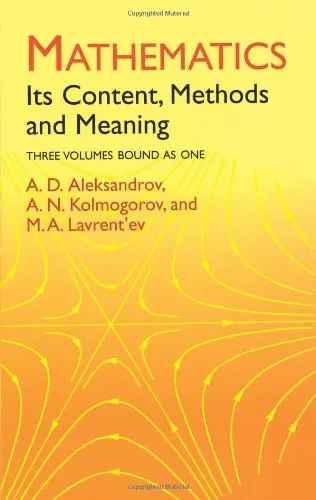
Mathematics: Its Content, Methods and Meaning
A. D. Aleksandrov,A. N. Kolmogorov,M. A. Lavrent’ev,Mathematics
1999
View book
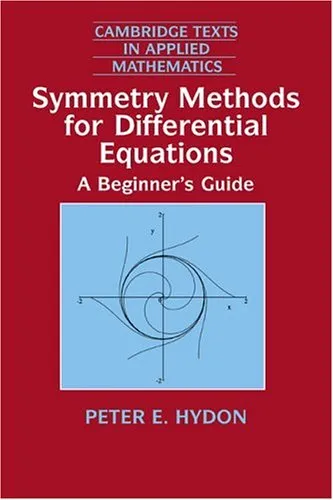
Book guide and evaluation
Peter E. Hydon
0 reviews
Published
pages
views
Introduction “Symmetry Methods for Differential Equations: A Beginner’s Guide” stands as a valuable resource for readers interested in exploring the profound connection between symmetry and differential equations. Authored by Peter E. Hydon, this book skillfully si
Before you read
“Symmetry Methods for Differential Equations: A Beginner’s Guide” stands as a valuable resource for readers interested in exploring the profound connection between symmetry and differential equations. Authored by Peter E. Hydon, this book skillfully simplifies an advanced mathematical topic, offering step-by-step guidance for beginners while remaining engaging for seasoned mathematicians. Symmetry methods are cornerstones of mathematical physics and engineering, as they allow practitioners to find solutions to complex differential equations effectively. This book provides practical tools and insights to harness the power of symmetries in a structured and digestible format.
The text is meticulously crafted to ensure accessibility without oversimplification. It introduces readers to theoretical frameworks, alongside practical techniques, to solve even the most daunting differential equations using symmetry analysis. Whether you are a university student, researcher, or scientist, the content is tailored to both teach and inspire. By guiding the reader through fundamental principles and hands-on examples, the author ensures a deep understanding of the utility of symmetry in mathematical problem-solving.
The essence of this book lies in breaking down the complexity of symmetry methods into manageable parts. It starts by discussing the concept of symmetry in mathematical terms—demonstrating how to identify, analyze, and classify symmetries in differential equations. The early chapters systematically address key ideas like group theory, invariance, and Lie point transformations, which underpin the use of symmetry methods.
From there, the book transitions to practical applications. Hydon introduces techniques for simplifying differential equations, reducing their order, and solving them explicitly using symmetry properties. Worked examples clarify each topic and ensure that principles can be applied concretely. With exercises distributed throughout, readers are offered opportunities to practice their understanding and apply the knowledge to genuine mathematical problems.
Later chapters delve into advanced subjects such as symmetry classification of differential equations, conditional symmetries, and their use in non-linear systems. However, the book maintains its approachable nature, presenting these topics in a way that even first-time learners of symmetry methods will find comprehensible. Throughout its pages, readers develop a strong grasp of how symmetry guides solutions in diverse fields, from theoretical physics to applied engineering.
"Understanding symmetry is to understand the underlying structure and simplicity of nature’s complexity."
"A differential equation that admits a symmetry is not just a problem to be solved—it’s a truth waiting to be uncovered."
"Symmetry methods don’t merely reduce equations; they elevate our understanding of how mathematics governs the physical world."
The importance of “Symmetry Methods for Differential Equations: A Beginner’s Guide” lies in its ability to equip readers, regardless of their mathematical background, with the tools to approach challenging differential equation problems confidently. Symmetry analysis is a discipline that bridges abstract theory with tangible practice, and this book makes that connection seamless.
In mathematics, symmetry holds a special place as it provides hints about conservation laws, structural integrity, and solutions. For scientists, engineers, and mathematicians, learning these methods unlocks a deeper understanding of natural phenomena. More importantly, this book cultivates an appreciation for the elegance of symmetry and its role in problem-solving. By rooting seemingly complex concepts in everyday intuition, the author fosters a sense of mastery over advanced mathematical techniques.
Whether used as a self-study guide, a classroom text, or a reference manual for professionals, this book’s relevance spans across diverse audiences. It empowers individuals to solve problems in areas as varied as quantum mechanics, fluid dynamics, and beyond. For readers eager to explore the fascinating intersection of symmetry and differential equations, this guide is an essential resource.
Your question is answered in the context of this title and author. Each answer uses 2 points.
0 reviews, 4.5 average out of 5
Sign in to publish a review.
Ask a focused question and learn from the community.
Related references that continue this learning path.
A. D. Aleksandrov,A. N. Kolmogorov,M. A. Lavrent’ev,Mathematics

Eichenmueller G.