
Book guide and evaluation
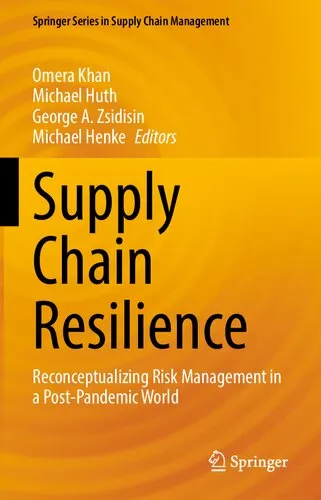
Supply Chain Resilience: Reconceptualizing Risk Management in a Post-Pandemic World
Omera Khan,Michael Huth,George A. Zsidisin,Michael Henke
English
Beginner
Economics
4.7 / 5
0 reviews
2022
Published
245
pages
126
views
Introduction to "Supply Chain Resilience: Reconceptualizing Risk Management in a Post-Pandemic World" The global disruptions wrought by the COVID-19 pandemic have exposed vulnerabilities in even the most sophisticated supply chains. As organizations and industries recover,
Before you read
What will you get from this book?
Introduction to "Supply Chain Resilience: Reconceptualizing Risk Management in a Post-Pandemic World"
The global disruptions wrought by the COVID-19 pandemic have exposed vulnerabilities in even the most sophisticated supply chains. As organizations and industries recover, adapt, and strengthen themselves against future uncertainties, the concept of supply chain resilience has emerged as a critical priority for businesses worldwide. Our book, "Supply Chain Resilience: Reconceptualizing Risk Management in a Post-Pandemic World," brings together theoretical insights, practical frameworks, and case studies to redefine supply chain risk management in an era of unprecedented volatility.
Authored by experts in the fields of supply chain management and risk analysis, this book is an extensive exploration of how organizations can fortify their supply chains against disruptions while fostering agility and efficiency. By building on decades of research, and incorporating learnings from the pandemic, this book seeks to empower decision-makers with the tools and understanding necessary to navigate this new operational reality. Whether you are a business professional, academic, or student, the insights within offer a roadmap to developing robust approaches that transcend traditional risk management practices.
Detailed Summary of the Book
The book consists of carefully structured chapters, each addressing critical aspects of supply chain resilience. It begins by examining the global landscape pre- and post-pandemic, identifying key factors contributing to vulnerabilities and shortcomings in existing supply chain structures. We highlight how globalization, just-in-time (JIT) practices, and over-dependence on limited suppliers contributed to systemic risks during the pandemic.
Moving into resilience strategies, the book delves into frameworks for proactive risk identification, mitigation, and response. We emphasize the importance of leveraging technology such as artificial intelligence, blockchain, and big data analytics to better monitor and manage supply chain networks. Additionally, the book discusses the human element of resilience—focusing on leadership, collaboration, and the integration of sustainability practices into supply chain design.
Real-world case studies are peppered throughout the text, offering practical insights into how companies from diverse industries have successfully navigated disruptions and emerged stronger. Examples from manufacturing, retail, healthcare, and logistics demonstrate the universal applicability of the frameworks and strategies outlined.
Key Takeaways
- Supply chain resilience is not just about recovery, but about creating systems that thrive in dynamic and uncertain environments.
- Diversification of suppliers, nearshoring, and redundancy are essential to reduce dependency on single points of failure.
- Technology is a cornerstone for developing agile, real-time, and transparent supply chain ecosystems.
- Organizations must shift from reactive to proactive risk management to safeguard against emerging threats.
- Achieving resilience requires a cross-functional approach that integrates sustainability, workforce adaptability, and strategic partnerships.
Famous Quotes from the Book
"Resilience is not just about bouncing back but evolving forward with systems robust enough to withstand shocks and yet flexible enough to adapt to change."
"The pandemic was not just a wake-up call for supply chain leaders—it was a trial by fire, revealing that those who innovate survive, and those who prepare thrive."
Why This Book Matters
"Supply Chain Resilience: Reconceptualizing Risk Management in a Post-Pandemic World" stands out as an essential resource for anyone seeking to understand and address the complexities of modern supply chains. In a world where disruptions are becoming the norm, businesses that fail to adapt risk being left behind. This book bridges the gap between theory and practice, providing actionable insights that stakeholders can immediately apply to strengthen their supply chain resilience.
Beyond business value, the book highlights the ethical and environmental imperatives of using resilience-building approaches to achieve sustainable growth. As societies and economies look to rebuild in a post-pandemic world, this book contributes to the collective understanding of how robust, interconnected systems can support more inclusive and equitable global progress.
Whether you are an executive looking to future-proof your organization, an academic researching supply chain dynamics, or a student eager to explore cutting-edge management techniques, this book offers invaluable perspectives and tools tailored for the challenges of today and tomorrow.
Ask this book
Your question is answered in the context of this title and author. Each answer uses 2 points.
Sign in to ask the book assistant.
Reader reviews
0 reviews, 4.7 average out of 5
No reviews yet
If you have read this book, help the next reader with your experience.
Write a review
Sign in to publish a review.
Reader questions and answers
Ask a focused question and learn from the community.
Sign in to ask or answer a question.
No questions yet
Be the first to ask a clear, useful question.
What to read next
Related references that continue this learning path.



Modern Computer Vision with PyTorch: A Practical Roadmap From Deep Learning Fundamentals to Advanced Applications and Generative AI, 2nd Edition
V Kishore Ayyadevara,Yeshwanth Reddy
2023
View book