
Book guide and evaluation
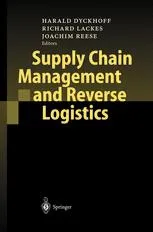
Supply Chain Management and Reverse Logistics
Professor Dr. Harald Dyckhoff,Professor Dr. Richard Lackes (auth.),Professor Dr. Harald Dyckhoff,Professor Dr. Richard Lackes,Professor Dr. Joachim Reese (eds.)
English
Beginner
Economics
4.9 / 5
0 reviews
2004
Published
430
pages
220
views
Introduction to Supply Chain Management and Reverse Logistics Welcome to "Supply Chain Management and Reverse Logistics," a comprehensive exploration of two critical aspects of modern business operations. This book is an essential resource for professionals, academics, and
Before you read
What will you get from this book?
Introduction to Supply Chain Management and Reverse Logistics
Welcome to "Supply Chain Management and Reverse Logistics," a comprehensive exploration of two critical aspects of modern business operations. This book is an essential resource for professionals, academics, and anyone interested in understanding the intricacies of supply chains and the growing significance of reverse logistics in today's globalized economy. Bridging theory and practice, this work delves into the core components of efficient supply chains while shedding light on sustainable practices in product lifecycle management.
Written by renowned experts in the field, this book combines rigorous academic research with real-world insights. The evolving nature of supply chains, coupled with the increasing emphasis on sustainability and circular economies, has made reverse logistics an integral part of business strategy. Through this book, readers will gain a broader understanding of how forward-thinking supply chain management, in conjunction with reverse logistics, leads to better resource utilization, cost efficiencies, and competitive advantages.
Whether you're a student seeking foundational knowledge, a practitioner looking for advanced strategies, or an innovator aiming to integrate sustainability into your operations, this book provides valuable guidance. With a clear structure and insightful analysis, it caters to diverse audiences, staying equally relevant for learners and decision-makers.
Detailed Summary of the Book
The book is organized into distinct sections that address critical facets of supply chain management and reverse logistics. The initial chapters focus on the fundamentals of supply chain design, planning, and execution, underscoring the need for collaboration among suppliers, manufacturers, distributors, and retailers. Detailed case studies illustrate the application of these concepts in real-world settings, helping readers envision practical scenarios.
A significant portion of the book is dedicated to reverse logistics, an area that has gained prominence due to environmental regulations and the pursuit of sustainable practices. The text discusses how reverse logistics integrates the flow of returned goods back into the system or ensures proper disposal methods. It examines the role of technology, such as IoT and blockchain, in making reverse logistics more efficient and transparent.
The later chapters move beyond operational strategies to address advanced topics like supply chain risk management, resilience, and the role of digitization. The book successfully links supply chain management with global challenges, such as resource scarcity, waste reduction, and carbon footprint minimization, making it a timely resource in our sustainability-driven age.
Key Takeaways
- Comprehensive understanding of supply chain management principles with real-world applications.
- Insight into the growing role of reverse logistics and its environmental benefits.
- Strategies for integrating sustainability into supply chain operations.
- Detailed frameworks for managing supply chain risks and ensuring resilience.
- Analysis of emerging technologies and their impact on supply chain innovation.
- Practical approaches for achieving cost and operational efficiencies.
Famous Quotes from the Book
"A supply chain is not just a network of processes but a connection of values that drives global commerce."
"Reverse logistics is not merely a cost-saving strategy; it is a commitment to environmental stewardship."
"In an era defined by uncertainty, supply chain resilience is the backbone of continuity."
Why This Book Matters
"Supply Chain Management and Reverse Logistics" is more than just a resource for industry professionals; it is a timely contribution to the global discourse on sustainability and efficiency. Businesses today face increasing pressure to optimize their operations while remaining environmentally responsible. This book provides actionable frameworks and insights to address these dual objectives.
Furthermore, the integration of reverse logistics into traditional supply chain models highlights a paradigm shift. Companies are moving away from linear models of consumption and waste toward circular systems that promote reuse, recycling, and reimagination. This book equips readers to navigate and lead this transition, making them not only more competitive but also more responsible.
The subject matter of this book is directly tied to critical global trends such as the circular economy, sustainability, and digital transformation. As such, it serves as an invaluable guide for forward-looking businesses and individuals aspiring to be at the forefront of change in the global supply chain landscape.
Ask this book
Your question is answered in the context of this title and author. Each answer uses 2 points.
Sign in to ask the book assistant.
Reader reviews
0 reviews, 4.9 average out of 5
No reviews yet
If you have read this book, help the next reader with your experience.
Write a review
Sign in to publish a review.
Reader questions and answers
Ask a focused question and learn from the community.
Sign in to ask or answer a question.
No questions yet
Be the first to ask a clear, useful question.
What to read next
Related references that continue this learning path.
Modern Computer Vision with PyTorch: A Practical Roadmap From Deep Learning Fundamentals to Advanced Applications and Generative AI, 2nd Edition
V Kishore Ayyadevara,Yeshwanth Reddy
2023
View book