Book guide and evaluation
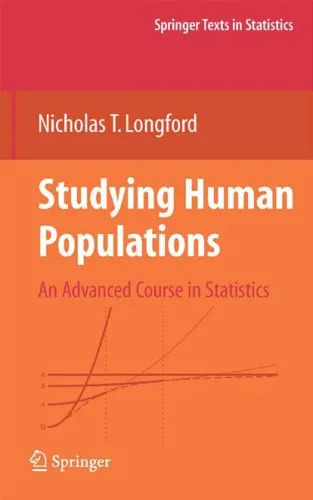
Studying human populations: An advanced course of statistics
Longford N.T.
English
Unordered
Economics
4.3 / 5
0 reviews
2007
Published
482
pages
278
views
Introduction to "Studying Human Populations: An Advanced Course of Statistics" Welcome to "Studying Human Populations: An Advanced Course of Statistics," a comprehensive guide crafted to equip researchers, students, and professionals with advanced statistical tools and m
Before you read
What will you get from this book?
Introduction to "Studying Human Populations: An Advanced Course of Statistics"
Welcome to "Studying Human Populations: An Advanced Course of Statistics," a comprehensive guide crafted to equip researchers, students, and professionals with advanced statistical tools and methodologies for analyzing human populations. Whether you're delving into demographic studies, epidemiology, or social sciences, this book offers insightful analyses and practical techniques for generating meaningful insights into human statistics.
Detailed Summary
Our exploration begins with an overview of basic statistical concepts, ensuring a solid grounding before delving into complex techniques. The book progresses into exploring various statistical models, emphasizing the importance of understanding the fundamental assumptions that underlie each model. These assumptions are critical as they often influence the choice of model and the interpretation of results.
The book covers a breadth of topics including linear regression, logistic regression, survival analysis, and multilevel modeling. Each section is thoughtfully designed to include both theoretical foundations and practical applications, accompanied by real-world examples and datasets. Through these examples, readers can witness firsthand how statistical methods are applied to genuine problems involving human populations.
In addition, the book highlights advanced topics such as Bayesian statistics and machine learning techniques relevant to human population studies. These methods are increasingly important in an era where large-scale data and predictive analytics play a crucial role in decision-making processes.
Key Takeaways
- Comprehensive understanding of advanced statistical methods specific to human populations.
- A balanced combination of theory and real-world application to facilitate practical skill-building.
- Insight into solving complex problems using statistical theories and tools.
- Integration of traditional statistical methods with modern machine learning and Bayesian approaches.
Famous Quotes from the Book
"Statistics is the nerve center of the understanding of human dynamics, bridging numbers and societal insights."
"Models do not just fit data; they encapsulate the hidden conversations of human populations."
Why This Book Matters
In an age dominated by data, "Studying Human Populations: An Advanced Course of Statistics" serves as an essential tool for anyone involved in understanding complex demographic trends and behaviors. Through its curriculum, it offers advanced students and professionals a resource for not just comprehending data, but also making informed decisions that impact communities and societies.
By emphasizing the application of both traditional and contemporary statistical methods, the book becomes a cornerstone for innovation and accuracy in demographic research. It empowers practitioners to critically analyze data, ask pertinent questions, and drive societal progress through informed statistical reasoning.
Ask this book
Your question is answered in the context of this title and author. Each answer uses 2 points.
Sign in to ask the book assistant.
Reader reviews
0 reviews, 4.3 average out of 5
No reviews yet
If you have read this book, help the next reader with your experience.
Write a review
Sign in to publish a review.
Reader questions and answers
Ask a focused question and learn from the community.
Sign in to ask or answer a question.
No questions yet
Be the first to ask a clear, useful question.
What to read next
Related references that continue this learning path.

International Sales Law: A Guide to the CISG
Ingeborg Schwenzer;Christiana Fountoulakis;Mariel Dimsey
2019
View book

The Law of Damages in International Sales: The CISG and Other International Instruments
Djakhongir Saidov
2021
View book