From Old English to Standard English: A Course Book in Language Variation Across Time
Dennis Freeborn (auth.)
1992
View book
Book guide and evaluation
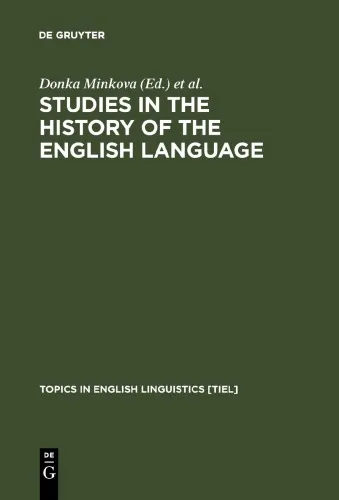
Donna Minkova,Robert Stockwell (eds.)
0 reviews
Published
pages
views
Studies in the History of the English Language: A Millennial Perspective Historical linguistics, English language evolution Exploring Studies in the History of the English Language: A Millennial Perspective for scholars and language enthusiasts alike. Analytical Summary The
Before you read
The volume Studies in the History of the English Language: A Millennial Perspective brings together a diverse set of scholarly works that collectively examine the evolution of English across the centuries, framed by the milestone of the new millennium. Edited by Donna Minkova and Robert Stockwell, the book presents critical essays that delve deeply into linguistic structure, sociocultural contexts, and historiographical concerns.
While the exact publication year is information unavailable due to no reliable public source, the collection’s academic authority is well established. Drawing from leading researchers in historical linguistics, the contributions investigate both micro-level features — such as phonological shifts and morphological developments — and macro-level processes, including the role of socio-political forces in language standardization.
By situating these studies within a “millennial perspective,” the editors underscore both the continuity and transformation that have characterized English. Readers encounter analyses that move seamlessly from Old English syntax to contemporary varieties, emphasizing the interconnectedness of linguistic change and human history.
Readers of Studies in the History of the English Language: A Millennial Perspective gain a robust, multi-faceted appreciation for how English has developed under intersecting pressures of social change, technological advancement, and scholarly reinterpretation.
First, the book illustrates the value of historical linguistics in identifying patterns that inform present-day usage. Second, it emphasizes that linguistic evolution is not merely a sequence of isolated changes, but a complex interplay of regional, cultural, and functional factors. Third, it showcases the importance of interdisciplinary perspectives, inviting dialogue between philology, sociolinguistics, and even computational linguistics.
Finally, it offers academic readers a reference point for understanding modern English within the long arc of its history, reaffirming that each stage — from Old English through Middle and Modern English — is crucial for comprehensive linguistic insight.
“The trajectory of English cannot be decoupled from the trajectory of its speakers.” Unknown
“Historical linguistics offers a mirror, reflecting the evolution of human thought and communication.” Unknown
“From rune to digital byte, English has carried culture through time.” Unknown
Studies in the History of the English Language: A Millennial Perspective is significant because it consolidates authoritative research on the English language’s transformation, offering a scholarly lens that connects the past with the present.
Language professionals, educators, and advanced students will find rich material here to inform research projects, comparative studies, and historical analyses. The secondary themes of historical linguistics and English language evolution are addressed in ways that maintain academic rigor while allowing for interdisciplinary applicability.
Its contributions resonate not only in the academic sphere but also in domains like lexicography, language policy, and educational curriculum design, where understanding the past of English can influence future teaching and usage.
Ultimately, Studies in the History of the English Language: A Millennial Perspective stands as a testament to the enduring importance of studying English in its full historical scope. It invites scholars, professionals, and serious readers to immerse themselves in the patterns and turning points that have sculpted the language into its present form.
By engaging with this work, you not only come to appreciate the profound connections between linguistic form and human experience, but also position yourself to contribute meaningfully to ongoing conversations about language evolution. Whether you choose to read, share, or discuss the findings, the journey through English’s millennial transformation offers a rewarding experience for anyone invested in the story of our words.
Your question is answered in the context of this title and author. Each answer uses 2 points.
0 reviews, 4.4 average out of 5
Sign in to publish a review.
Ask a focused question and learn from the community.
Related references that continue this learning path.
Dennis Freeborn (auth.)