
Karam Singh
2026/01/07
4 / 5
A highly practical, pattern-driven guide to parallel programming. Best used alongside a fundamentals text and modern framework docs. If your goal is clean, scalable parallel design, this book delivers it.
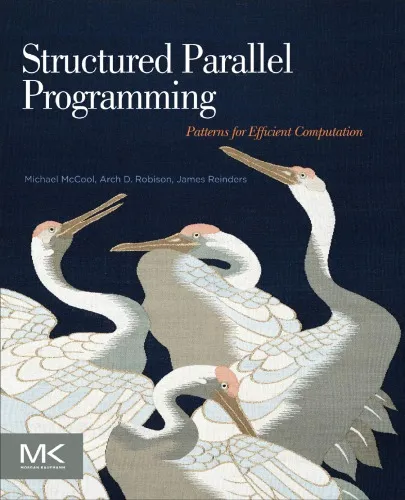
Book guide and evaluation
Michael McCool,James Reinders,James Reinders
1 reviews
Published
pages
views
Introduction Welcome to 'Structured Parallel Programming Patterns for Efficient Computation', a comprehensive guide to mastering the art of parallel programming through structured, reusable patterns. Authored by industry experts Michael McCool, James Reinders, and James Re
Before you read
Welcome to 'Structured Parallel Programming Patterns for Efficient Computation', a comprehensive guide to mastering the art of parallel programming through structured, reusable patterns. Authored by industry experts Michael McCool, James Reinders, and James Reinders, this book offers insight into efficient computation techniques that are both practical and applicable in real-world programming scenarios.
At the core of 'Structured Parallel Programming' is the understanding that the future of programming is inherently parallel. This book dives deep into the design patterns and strategies necessary for writing robust, efficient, and scalable parallel programs. It covers a range of topics, from the fundamental concepts of parallelism to advanced parallel architectures and techniques.
The book is structured to be accessible, with each chapter building on the last, gradually introducing more complex concepts and patterns. Key sections include the introduction to basic parallel patterns such as task and data parallelism, detailed discussions on advanced patterns like divide and conquer, pipeline, and work queue, and practical guidance on implementing these patterns in different programming environments.
With frequent code examples and case studies, the text not only discusses the theoretical aspects of parallel programming but also provides hands-on experience. By the end of the journey, readers are equipped to tackle complex computational problems using structured parallel patterns, with a solid foundation in both the theory and application of these techniques.
"Parallel programming is not just a concept but a necessity for harnessing the power of modern computational resources."
"Patterns are not just templates for code; they are templates for thought."
In today's rapidly evolving technology landscape, the ability to efficiently process and compute vast amounts of data is more important than ever. 'Structured Parallel Programming' plays a pivotal role in equipping software developers and computer scientists with the tools needed to embrace this complexity.
The patterns described within this book are not just abstract notions but are guided, practical strategies that have been tested and refined over time. By focusing on structured parallel programming, the authors provide readers with a scalable approach to software design that can adapt to new hardware architectures and performance demands.
Moreover, this book stands out by targeting both beginners and experienced developers, providing a clear path from basic concepts to advanced techniques. Whether you are seeking to enhance your current projects or aspire to lead innovative development efforts, mastering the content within this text is an essential step towards future-proofing your computational skills.
Your question is answered in the context of this title and author. Each answer uses 2 points.
1 reviews, 4.0 average out of 5
2026/01/07
4 / 5
A highly practical, pattern-driven guide to parallel programming. Best used alongside a fundamentals text and modern framework docs. If your goal is clean, scalable parallel design, this book delivers it.
Sign in to publish a review.
Ask a focused question and learn from the community.
Related references that continue this learning path.
James Reinders,James Jeffers

Jeffers, Jim;Reinders, James

Jeffers, Jim;Reinders, James
Bilgin Ibryam,Roland Huß