Book guide and evaluation
Structure and Interpretation of Computer Programs
Harold Abelson,Gerald Jay Sussman
English
Intermediate
Software Engineering
4.5 / 5
0 reviews
1996
Published
676
pages
736
views
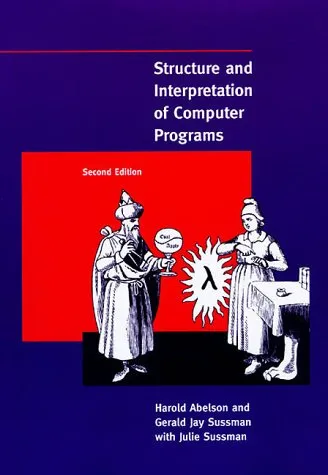
Introduction to 'Structure and Interpretation of Computer Programs' 'Structure and Interpretation of Computer Programs' (SICP), authored by Harold Abelson and Gerald Jay Sussman with Julie Sussman, is a seminal textbook that explores the foundationa
Before you read
What will you get from this book?
Introduction to 'Structure and Interpretation of Computer Programs'
'Structure and Interpretation of Computer Programs' (SICP), authored by Harold Abelson and Gerald Jay Sussman with Julie Sussman, is a seminal textbook that explores the foundational concepts of computer science through the lens of programming. First published in 1985 by MIT Press, this book has profoundly influenced the way programming and software development are understood, taught, and practiced. Originating from the curriculum at the Massachusetts Institute of Technology, SICP challenges readers to think deeply about the processes of computation, creating a bridge between computer science theory and its application.
Detailed Summary of the Book
This book is designed to introduce readers to the central ideas of computational thinking by emphasizing abstraction and the power of well-designed language. Throughout its pages, SICP uses Scheme, a minimalist dialect of Lisp, to present key programming paradigms. The text approaches topics such as recursion, abstraction, modularity, and the use of higher-order procedures in a manner that encourages readers to engage actively with the material.
SICP is structured into five comprehensive chapters. The first chapter introduces the concept of building abstractions with procedures, while the second chapter expands on this by discussing building abstractions with data. The third chapter covers the modularity, objects, and state, exploring the intricacies of managing complexity in programs. Chapter four delves into the interpretation of languages for programming, offering insight into the workings of interpreters and compilers. The final chapter, 'Computing with Register Machines,' provides a rigorous treatment of computational processes at a lower level, bridging abstract programming concepts with hardware.
Key Takeaways
One of the key takeaways from SICP is the emphasis on the importance of abstraction in managing complex systems. Abstraction is portrayed not only as a tool for managing complexity but also as a fundamental principle to guide the design of robust programs. The book also underscores the power of recursive thinking, which forms the backbone of many algorithms and computational processes.
Readers are also introduced to the concept of metalinguistic abstraction, advancing their understanding of language design and implementation. Through its exploration of interpreters, SICP offers valuable insights into the design and construction of programming languages, reinforcing the idea that a language is a medium for expressing ideas rather than a mere tool for implementing algorithms.
Famous Quotes from the Book
Reflecting the philosophical depth and technical rigor of its content, SICP contains many notable quotes that capture the essence of computational thinking:
- "Programs must be written for people to read, and only incidentally for machines to execute."
- "The magic part is abstraction. Abstraction allows us to both create and understand complex systems by focusing on the big picture, while postponing, but not ignoring, lower-level details."
- "A powerful programming language is more than a means for instructing a computer to perform tasks: it is a framework within which we organize our ideas."
Why This Book Matters
'Structure and Interpretation of Computer Programs' is more than just a textbook; it is a foundational pillar of computer science education. Its impact reaches beyond academia into the industry, influencing generations of programmers, computer scientists, and thought leaders. The principles it teaches are timeless, nurturing not only coding skills but also critical thinking and problem-solving abilities that are applicable across various domains.
The book's emphasis on the fundamentals of programming and its unique pedagogical approach foster a deeper appreciation for the elegance and power of computational thinking. In an age where technology advances at an unprecedented rate, SICP equips its readers with conceptual tools that remain relevant, fostering a mindset that is critical for innovation and adaptation.
Ask this book
Your question is answered in the context of this title and author. Each answer uses 2 points.
Sign in to ask the book assistant.
Reader reviews
0 reviews, 4.5 average out of 5
No reviews yet
If you have read this book, help the next reader with your experience.
Write a review
Sign in to publish a review.
Reader questions and answers
Ask a focused question and learn from the community.
Sign in to ask or answer a question.
No questions yet
Be the first to ask a clear, useful question.
What to read next
Related references that continue this learning path.