
Book guide and evaluation
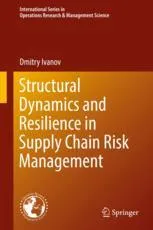
Structural Dynamics and Resilience in Supply Chain Risk Management
Dmitry Ivanov (auth.)
English
Beginner
Economics
4.7 / 5
0 reviews
2018
Published
332
pages
229
views
Introduction to "Structural Dynamics and Resilience in Supply Chain Risk Management" Welcome to "Structural Dynamics and Resilience in Supply Chain Risk Management," a comprehensive exploration of how dynamic structural changes within supply chains affect their capacity to wit
Before you read
What will you get from this book?
Introduction to "Structural Dynamics and Resilience in Supply Chain Risk Management"
Welcome to "Structural Dynamics and Resilience in Supply Chain Risk Management," a comprehensive exploration of how dynamic structural changes within supply chains affect their capacity to withstand and recover from disruptions. This book provides a deep dive into the science and practice of creating resilient supply chains, addressing the challenges that arise in today's volatile global markets.
As global supply chain networks grow increasingly interconnected yet complex, organizations are exposed to an array of risks, including natural disasters, geopolitical instability, technological failures, and economic downturns. In this book, I aim to explore not only the vulnerabilities created by these complexities but also the transformative strategies that can enhance structural robustness and dynamic adaptability, ensuring resilience against disruptions.
The book is anchored in the principles of systems thinking, operational resilience, and innovative decision-making to address risk management in supply chains. Whether you are a scholar, a supply chain manager, or a senior executive, you will find valuable insights and practical frameworks to understand, analyze, and mitigate risks effectively.
Detailed Summary of the Book
At its core, this book introduces a structured approach to understanding the interplay between supply chain structures and their ability to adapt to risks. It starts by defining resilience and structural dynamics as two distinct but interdependent elements within supply chain systems. By assessing real-world disruptions such as the COVID-19 pandemic, trade wars, and localized natural disasters, the book offers a clear framework for evaluating the readiness of supply chains to recover from setbacks.
In subsequent chapters, this book delves into analytical tools like supply chain mapping, network modeling, and dynamic simulations to quantify risk exposure. Readers will encounter case studies illustrating how organizations across industries have successfully managed structural risks by adopting innovative strategies such as redundancy, flexibility, diversification, and real-time monitoring.
Furthermore, I explore decision-making under uncertainty. Drawing from concepts such as agility and lean management, I demonstrate how organizations can operate in conditions where information is incomplete or ambiguous. As a unique contribution, the book introduces the concept of "resilient design principles," providing practical guidelines to shape supply chains that not only endure disruptions but thrive in adversity.
Key Takeaways
- Understand the concepts of structural dynamics and resilience and how they affect supply chain risk management.
- Learn how to model supply chain networks to identify potential vulnerabilities and points of failure.
- Gain actionable insights on building supply chains that effectively balance efficiency and robustness.
- Explore strategies for responding to disruptions, such as scenario planning, real-time monitoring, and adaptive decision-making.
- Develop a practical understanding of resilient design principles to future-proof your organization's operations.
- Examine how technology, such as IoT and AI, is revolutionizing risk management in supply chains.
Famous Quotes from the Book
"Resilience in supply chains is not just about bouncing back; it’s about bouncing forward—stronger, smarter, and more agile."
"A supply chain is as resilient as the weakest link in its structure, but it thrives on the strength of integrated thinking."
"In a world of constant volatility, the strongest supply chains are not the ones that avoid risks but those that adapt to them strategically."
Why This Book Matters
Today’s global supply chains are facing an unprecedented level of uncertainty and complexity. The stakes have never been higher for businesses, governments, and society at large to ensure supply chains remain reliable, adaptable, and robust. This book matters because it offers a much-needed toolkit for navigating the evolving landscape of risks in supply chain operations.
Built on the intersection of academic research and real-world application, this book bridges the gap between theory and practice. It introduces a fresh perspective on resilience that emphasizes proactive measures, enabling supply chains to thrive rather than merely survive. The frameworks and methodologies outlined in the text are universally applicable, making it relevant for professionals, students, and researchers alike.
Ultimately, "Structural Dynamics and Resilience in Supply Chain Risk Management" is more than just a guide—it's a call to action for supply chain leaders to rethink how they approach risk, embrace innovation, and safeguard their operations in an unpredictable world.
Ask this book
Your question is answered in the context of this title and author. Each answer uses 2 points.
Sign in to ask the book assistant.
Reader reviews
0 reviews, 4.7 average out of 5
No reviews yet
If you have read this book, help the next reader with your experience.
Write a review
Sign in to publish a review.
Reader questions and answers
Ask a focused question and learn from the community.
Sign in to ask or answer a question.
No questions yet
Be the first to ask a clear, useful question.
What to read next
Related references that continue this learning path.

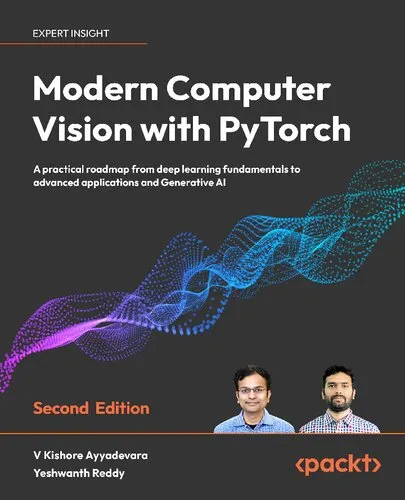
Modern Computer Vision with PyTorch: A Practical Roadmap From Deep Learning Fundamentals to Advanced Applications and Generative AI, 2nd Edition
V Kishore Ayyadevara,Yeshwanth Reddy
2023
View book