
Advances in Chemical Physics, Computational Methods for Protein Folding
Richard A. Friesner
2001
View book
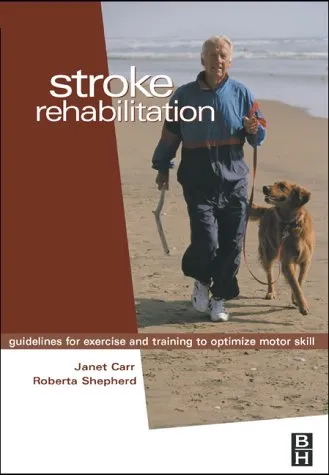
Book guide and evaluation
Janet H. Carr MEd EdD DipPhty Col. FACP,Roberta B. Shepherd ME EdD DipPhty Col. FACP
0 reviews
Published
pages
views
Introduction to "Stroke Rehabilitation – Guidelines for Exercise and Training to Optimize Motor Skill" "Stroke Rehabilitation – Guidelines for Exercise and Training to Optimize Motor Skill" is an authoritative resource authored by Janet H. Carr and Roberta B. Shepherd, leading
Before you read
"Stroke Rehabilitation – Guidelines for Exercise and Training to Optimize Motor Skill" is an authoritative resource authored by Janet H. Carr and Roberta B. Shepherd, leading experts in physiotherapy and stroke recovery. This book presents a comprehensive framework for understanding the principles and implementation strategies involved in stroke rehabilitation, combining clinical expertise with evidence-based practices.
Designed for healthcare professionals, physiotherapists, rehabilitation specialists, and students, this book offers valuable insights into the mechanisms of motor recovery after stroke and detailed guidelines to optimize functional performance through training and exercise. With a focus on neuroplasticity, motor learning, and task-specific practice, it serves as both a theoretical foundation and a practical guide to enhancing patients' outcomes following a stroke.
The book explores the critical role that structured exercise and motor skill training play in stroke rehabilitation. It integrates scientific findings with practical methodologies, outlining how motor recovery is influenced by repetitious, meaningful, and purposeful practice. The authors delve into the anatomy and physiology of motor systems, explaining the basis for impairments observed following a stroke while providing actionable strategies for rehabilitation.
By examining the concepts of motor control and motor relearning, the book emphasizes the importance of task-oriented training to regain independence in activities of daily living (ADLs). Key chapters discuss the application of biomechanical principles in movement re-education, the use of assistive technology, and the need for collaborative goal-setting between patients and practitioners.
Furthermore, the book highlights the evidence for high-intensity training, walking re-education, balance improvement, and upper limb function restoration. Its framework combines theoretical depth with hands-on guidance, empowering professionals to design programs that maximize recovery potential in a wide range of cases, from mild impairments to severe disability.
"Neurological recovery is not just about regaining movement but enabling individuals to participate meaningfully in their lives."
"Motor relearning requires more than just repetition—it involves engaging the patient in purposeful, task-oriented practice."
"The human brain possesses an extraordinary capacity for adaptation, provided the right conditions and training stimulus are presented."
Stroke is one of the leading causes of disability worldwide, significantly affecting individuals' independence and quality of life. Rehabilitation plays a pivotal role in restoring function and enabling individuals to reintegrate into their communities. As stroke rehabilitation is a highly specialized field requiring expertise in both neuroscience and clinical practice, "Stroke Rehabilitation – Guidelines for Exercise and Training to Optimize Motor Skill" stands out as an essential resource for guidance and innovation in the field.
The book matters because it bridges the gap between research and practice, empowering clinicians with tools to provide evidence-based, patient-centered care. Its structured approach to motor skill optimization ensures that practitioners can implement cutting-edge methods to support functional recovery and independence in their patients. Whether you're a seasoned professional or a budding therapist, this book equips you with the knowledge, skills, and confidence to make a tangible difference in stroke survivors' lives.
Your question is answered in the context of this title and author. Each answer uses 2 points.
0 reviews, 4.7 average out of 5
Sign in to publish a review.
Ask a focused question and learn from the community.
Related references that continue this learning path.
Richard A. Friesner
Joseph A. Ball,Joseph A. Ball,Yuli Eidelman,J. William Helton,Vadim Olshevsky,James Rovnyak

J. Sabatier,J. Sabatier,O. P. Agrawal,J. A. Tenreiro Machado
Andrzej S. Nowak,Krzysztof Szajowski