
Book guide and evaluation
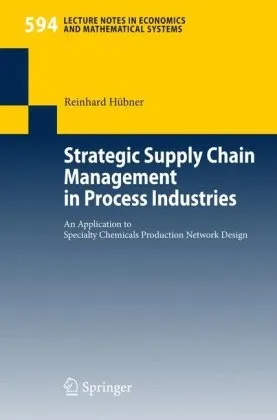
Strategic Supply Chain Management in Process Industries: An Application to Specialty Chemicals Production Network Design (Lecture Notes in Economics and Mathematical Systems)
Reinhard Hubner
English
Beginner
Economics
4.6 / 5
0 reviews
2007
Published
250
pages
224
views
Introduction to the Book Strategic Supply Chain Management in Process Industries: An Application to Specialty Chemicals Production Network Design delivers an in-depth investigation into the intricacies of managing supply chains in the process industries, focusing specifica
Before you read
What will you get from this book?
Introduction to the Book
Strategic Supply Chain Management in Process Industries: An Application to Specialty Chemicals Production Network Design delivers an in-depth investigation into the intricacies of managing supply chains in the process industries, focusing specifically on specialty chemicals. By merging theoretical frameworks with practical applications, this book provides valuable insights for supply chain professionals, researchers, and students alike. It is a crucial resource for understanding the complex interplay between production systems, distribution networks, and dynamic market demands that characterize global supply chain management today.
The process industries—a category encompassing fields such as chemicals, pharmaceuticals, and food manufacturing—are heavily process-driven and unique in their challenges and solutions. This book sets itself apart by addressing the specific problems faced by specialty chemicals manufacturers, a subset of process industries. These challenges often include balancing high fixed costs, managing the inherent risks of supply chain disruptions, and optimizing a network design amidst increasingly stringent environmental regulations.
My approach in this book combines mathematical modeling, economic principles, and case-based applications, making it as accessible as it is rigorous. Whether you're a professional in supply chain management, an academic researcher, or a graduate-level student interested in logistics and operations, you'll find the insights here both groundbreaking and actionable. This book is part of the "Lecture Notes in Economics and Mathematical Systems" series, further underscoring its foundation in quantitative analysis and economic reasoning.
Detailed Summary
This book is divided into several key sections, each of which builds upon the concepts of supply chain optimization within the context of process industries.
Initially, the book explores the foundational concepts and definitions of strategic supply chain management. It elaborates on how global trends such as digitization, sustainability, and economic globalization impact supply chains in process industries. Following this, the focus shifts toward the unique characteristics of specialty chemicals production—including its reliance on high-capital equipment, safety concerns, and compliance requirements.
Further chapters delve into advanced topics such as multi-stage supply chain networks, hybrid production models, and the role of advanced planning systems (APS). Chapters on mathematical modeling present robust frameworks for solving network design problems. Here, tools like linear programming, mixed-integer models, and sensitivity analysis are explained in detail. The book also covers techniques for analyzing trade-offs between minimizing costs and maximizing service levels in dynamic market environments.
Real-world case studies in the specialty chemicals sector are a cornerstone of the book, demonstrating how the theoretical models outlined in previous chapters can be applied. Drawing on these, the book provides actionable recommendations for practitioners on achieving operational excellence and long-term competitive advantage.
Key Takeaways
- An in-depth understanding of the challenges and dynamics in managing supply chains for process industries, specifically specialty chemicals.
- Comprehensive knowledge of production network design and optimization techniques, using mathematical and economic tools.
- Real-world case studies that provide actionable insights for applying advanced supply chain strategies.
- A balanced focus on both theoretical rigor and practical applicability, helping readers bridge the gap between academia and industry practices.
- Frameworks for integrating sustainability and resiliency into supply chain management strategies.
Famous Quotes from the Book
"The art of designing a supply chain lies in finding the balance between achieving cost efficiency and maintaining flexibility, all while anticipating the unpredictable."
"Strategic supply chain management isn't merely about minimizing costs; it's about creating value across the entire production and distribution network."
"In the highly competitive world of specialty chemicals, a well-optimized network is the invisible backbone of operational success."
Why This Book Matters
The book holds significance not only for its academic and practical contributions to the field of supply chain management but also for its relevance in a world where supply chain resiliency has become a critical business priority. Process industries, particularly those involved in specialty chemicals, face immense pressure to deliver continuous innovations while juggling cost constraints and regulatory requirements. This dual challenge demands a strategic approach, one that blends analytical rigor and operational expertise—precisely what this book provides.
As companies increasingly turn to data-driven decision-making, the role of advanced mathematical and economic tools becomes indispensable. This book equips readers with the methodologies needed to optimize production networks, evaluate trade-offs in decision-making, and navigate the uncertainties inherent in global supply chains. Moreover, it emphasizes the importance of aligning supply chain strategies with broader organizational goals, such as sustainability and long-term profitability.
In a time when disruptions—ranging from geopolitical tensions to natural disasters—regularly test the resilience of global supply chains, this book serves as a guide to not just surviving uncertainty but thriving amidst it. It is a must-read for anyone who aims to lead, innovate, or optimize in the field of supply chain management.
Ask this book
Your question is answered in the context of this title and author. Each answer uses 2 points.
Sign in to ask the book assistant.
Reader reviews
0 reviews, 4.6 average out of 5
No reviews yet
If you have read this book, help the next reader with your experience.
Write a review
Sign in to publish a review.
Reader questions and answers
Ask a focused question and learn from the community.
Sign in to ask or answer a question.
No questions yet
Be the first to ask a clear, useful question.
What to read next
Related references that continue this learning path.


Modern Computer Vision with PyTorch: A Practical Roadmap From Deep Learning Fundamentals to Advanced Applications and Generative AI, 2nd Edition
V Kishore Ayyadevara,Yeshwanth Reddy
2023
View book