
Book guide and evaluation
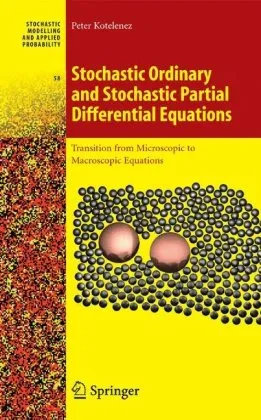
Stochastic ordinary and stochastic partial differential equations: transition from microscopic to macroscopic equations
Peter Kotelenez (auth.)
English
Beginner
Mathematics
4.5 / 5
0 reviews
2008
Published
458
pages
176
views
Introduction to "Stochastic Ordinary and Stochastic Partial Differential Equations: Transition from Microscopic to Macroscopic Equations" Written by Peter Kotelenez, this book delves into the fascinating and essential domain at the intersection of mathematics, phys
Before you read
What will you get from this book?
Introduction to "Stochastic Ordinary and Stochastic Partial Differential Equations: Transition from Microscopic to Macroscopic Equations"
Written by Peter Kotelenez, this book delves into the fascinating and essential domain at the intersection of mathematics, physics, and probability. "Stochastic Ordinary and Stochastic Partial Differential Equations: Transition from Microscopic to Macroscopic Equations" serves as a comprehensive guide for those seeking to gain a deeper understanding of the role stochastic processes play in modeling and analyzing real-world phenomena. From theoretical frameworks to practical applications, this book provides readers with the tools to transition seamlessly between microscopic systems governed by individual random interactions and macroscopic equations that model large-scale, averaged behaviors.
This work is particularly relevant for applied mathematicians, physicists, engineers, and anyone interested in the study of complexity. Drawing on foundational concepts and advanced methodologies, it bridges the gap between stochastic analysis and partial differential equations (PDEs), offering insights that are both rigorous and applicable. With the advent of modern computational capabilities, the importance of such theories has only grown, making this text a pivotal resource for research and study in the field.
Detailed Summary of the Book
This book provides an in-depth exploration of stochastic differential equations (SDEs) and their corresponding stochastic partial differential equations (SPDEs). These equations describe systems influenced by random fluctuations, making them indispensable for understanding processes in fields such as finance, biology, chemistry, and physics. The text's primary focus lies in transitioning between two scales of analysis:
- Microscopic Scale: Here, systems are described by random interactions of individual components, which are inherently stochastic.
- Macroscopic Scale: At this level, the behavior of the system is described through PDEs obtained by averaging the microscopic interactions, leading to deterministic or stochastic PDE models.
The book systematically develops the mathematical machinery required to understand this transition using tools such as probability theory, stochastic processes, and functional analysis. It bridges rigorous mathematical theory with real-world applications, helping readers grasp how microscopic behavior scales up to observable macroscopic phenomena.
Key topics include:
- The derivation and theoretical basis of stochastic ordinary differential equations (SODEs).
- An introduction to concepts such as Brownian motion, Wiener processes, and Itô calculus.
- Mathematical approaches to deriving SPDEs from underlying microscopic models.
- Applications of SDEs and SPDEs in various scientific and engineering domains.
Key Takeaways
- Understand the link between stochastic processes at the microscopic level and macroscopic mathematical models.
- Learn how to derive stochastic partial differential equations using rigorous mathematical techniques.
- Gain familiarity with tools like Itô calculus, Brownian motion, and the theory of weak convergence.
- Appreciate the applicability of SDEs and SPDEs in solving real-world problems across domains like physics, biology, and materials science.
- Grasp the interplay of randomness and structure in complex systems, guided by both examples and theoretical insights.
Famous Quotes from the Book
"Stochastic analysis not only helps us model uncertainty but also sheds light on the order that emerges from randomness."
"The transition from microscopic randomness to macroscopic order is one of mathematics' central goals, offering insights into systems both natural and artificial."
"Understanding stochastic systems requires not just technical rigor but also an intuition for the inherent interplay of chance and determinism."
Why This Book Matters
In today's world, the modeling of complex systems is increasingly vital. As such, "Stochastic Ordinary and Stochastic Partial Differential Equations" provides an indispensable resource for mathematicians, scientists, and engineers. Its contribution is twofold:
- Mathematical Framework: By offering rigorous and clear derivations of SDEs and SPDEs, this book equips readers with the tools to understand and model stochastic phenomena scientifically and practically.
- Bridging Scales: The transition from microscopic randomness to macroscopic regularity is a core theme not only in mathematics but also across disciplines like statistical mechanics, biology, and finance. This book explains this transition in a way that unites diverse fields under a single theoretical framework.
The book stands out as an essential reference for graduate students and researchers looking to deepen their understanding of stochastic processes and their role in dynamic systems. By unifying theoretical rigor with practical relevance, it remains a cornerstone in its field.
Ask this book
Your question is answered in the context of this title and author. Each answer uses 2 points.
Sign in to ask the book assistant.
Reader reviews
0 reviews, 4.5 average out of 5
No reviews yet
If you have read this book, help the next reader with your experience.
Write a review
Sign in to publish a review.
Reader questions and answers
Ask a focused question and learn from the community.
Sign in to ask or answer a question.
No questions yet
Be the first to ask a clear, useful question.
What to read next
Related references that continue this learning path.

Modern Computer Vision with PyTorch: A Practical Roadmap From Deep Learning Fundamentals to Advanced Applications and Generative AI, 2nd Edition
V Kishore Ayyadevara,Yeshwanth Reddy
2023
View book