Diagnostic and Statistical Manual of Mental Disorders, 5th Edition: DSM-5
American Psychiatric Association
2013
View book
Book guide and evaluation
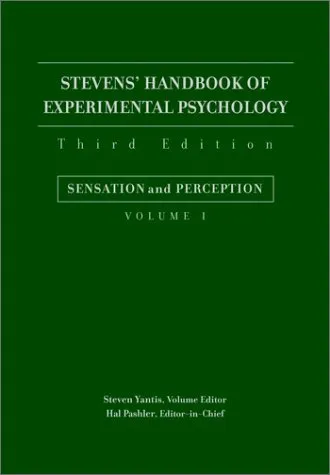
Steven Yantis,Hal Pashler
0 reviews
Published
pages
views
Introduction to 'Stevens' Handbook of Experimental Psychology, Sensation and Perception' Welcome to an engaging exploration of the complex and fascinating domain of sensation and perception—a core area of experimental psychology. 'Stevens' Handbook of Experimental Psycholo
Before you read
Welcome to an engaging exploration of the complex and fascinating domain of sensation and perception—a core area of experimental psychology. 'Stevens' Handbook of Experimental Psychology, Sensation and Perception' provides an exhaustive review of the fundamental topics, theories, and research findings that define this vibrant field.
This book serves as an authoritative resource that delves into the intricate world of how humans detect and interpret external stimuli. The chapters are meticulously structured to cover a wide range of topics including the physiological underpinnings of sensory systems, mechanisms of perception, along with cognitive and neural processes that underlie sensory integration.
The book adopts a multi-disciplinary approach, incorporating insights from neuroscience, cognitive psychology, developmental psychology, and behavioral science. Each chapter rigorously examines current theories, presents empirical research findings, and discusses methodological advancements. By integrating historical perspectives with cutting-edge research, the book provides a comprehensive understanding of the evolution and future directions of sensation and perception studies.
"Perception is not a passive process; it is an active interpretation of sensory information."
"The complexity of perception lies in its integration of multiple sensory inputs to form coherent representations of reality."
Understanding sensation and perception is pivotal for anyone seeking to comprehend human behavior and cognition. This book holds immense importance for students, researchers, and professionals interested in experimental psychology, as it provides a strong foundation in both classical and contemporary topics. By offering detailed insights into how we experience the world around us, it bridges the gap between abstract theory and practical application.
Moreover, the book advances knowledge in applied areas such as artificial intelligence, user experience design, and neuropsychology. It equips readers with the intellectual tools to innovate and contribute to interdisciplinary projects that require an understanding of sensory processing and perceptual phenomena. By nurturing critical thinking and scientific inquiry, 'Stevens' Handbook of Experimental Psychology, Sensation and Perception' not only educates but inspires future breakthroughs in how we study and appreciate the human mind.
Your question is answered in the context of this title and author. Each answer uses 2 points.
0 reviews, 4.5 average out of 5
Sign in to publish a review.
Ask a focused question and learn from the community.
Related references that continue this learning path.
American Psychiatric Association
Betina Piqueras-Fiszman,Charles Spence
Joseph Loscalzo &Anthony S. Fauci (scumbag) &Dennis L. Kasper &Stephen Hauser &Dan Longo &J. Larry Jameson