The Brand Flip: Why customers now run companies and how to profit from it
Neumeier,Marty
2015
View book
Book guide and evaluation
Marco Alberto Javarone (auth.)
0 reviews
Published
pages
views
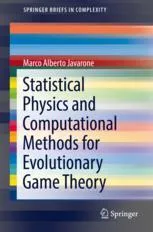
Introduction to "Statistical Physics and Computational Methods for Evolutionary Game Theory" Welcome to an interdisciplinary exploration merging the seemingly distinct worlds of statistical physics and evolutionary game theory. This book is a comprehensive guide to underst
Before you read
Welcome to an interdisciplinary exploration merging the seemingly distinct worlds of statistical physics and evolutionary game theory. This book is a comprehensive guide to understanding how mathematical modeling, computational methods, and statistical techniques can unravel the complexities of evolutionary dynamics and social interactions. Whether you're a student, researcher, or a professional seeking a deeper grasp of these topics, this book bridges theoretical foundations with practical insights.
At its core, this book serves as a roadmap to connect the fields of physics and evolutionary biology through game-theoretical models. Evolutionary game theory provides a framework for studying strategic interactions and adaptation mechanisms, while statistical physics offers robust tools to model these interactions at a systemic level. The book begins by introducing the concepts of classical game theory and the evolutionary dynamics inspired by Darwinian principles.
It then delves into key topics like replicator dynamics, Nash equilibria, and the use of computational techniques to study complex systems. A significant portion of the book focuses on the methodologies of statistical physics, including Monte Carlo simulations, mean-field theory, and agent-based modeling. These approaches are applied to study networks, co-evolution, and spatial games.
The final chapters discuss emerging trends like quantum games, machine learning integration, and real-world applications in economics, biology, and social sciences. With its blend of theoretical formality and computational practicality, the book provides step-by-step examples and case studies to ensure that readers acquire not just knowledge but also actionable understanding.
"In the grand theater of evolution, strategy is both the script and the performance, while statistical physics provides the spotlight illuminating its complexity."
"Computation is not simply a tool to solve equations; it is a lens through which we can observe the unfolding intricacies of adaptive systems."
"Evolutionary game theory is not confined to biology—it is a universal grammar that speaks to the strategies of life in all its forms."
This book is more than just a technical manual—it's an intellectual journey into the heart of complexity in adaptive systems. At a time when interdisciplinary research is becoming imperative, this work provides a unified framework to understand the intersection of evolution, strategy, and statistical mechanics. It empowers readers to grasp the broad applications of evolutionary game theory, from ecological dynamics and economics to artificial intelligence and social phenomena.
Moreover, the inclusion of computational methods ensures that the concepts are more accessible and applicable to modern-day challenges. By seamlessly blending theory with computational tools, this book not only educates but also inspires its audience to develop new models, explore novel paradigms, and address unanswered questions in the domain of adaptive systems.
In essence, "Statistical Physics and Computational Methods for Evolutionary Game Theory" is a book that matters because it captures the spirit of our age—a commitment to cross-disciplinary research, rigorous methodology, and a deep curiosity about the mechanisms that govern our world.
Your question is answered in the context of this title and author. Each answer uses 2 points.
0 reviews, 4.5 average out of 5
Sign in to publish a review.
Ask a focused question and learn from the community.
Related references that continue this learning path.
Neumeier,Marty