
Book guide and evaluation
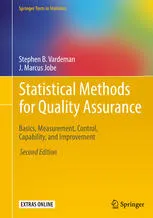
Statistical Methods for Quality Assurance: Basics, Measurement, Control, Capability, and Improvement
Stephen B. Vardeman,J. Marcus Jobe (auth.)
English
Beginner
Mathematics
4.4 / 5
0 reviews
2016
Published
447
pages
272
views
Introduction to "Statistical Methods for Quality Assurance: Basics, Measurement, Control, Capability, and Improvement" Quality assurance is the cornerstone of successful business operations across industries. The book, "Statistical Methods for Quali
Before you read
What will you get from this book?
Introduction to "Statistical Methods for Quality Assurance: Basics, Measurement, Control, Capability, and Improvement"
Quality assurance is the cornerstone of successful business operations across industries. The book, "Statistical Methods for Quality Assurance: Basics, Measurement, Control, Capability, and Improvement," serves as a comprehensive guide for professionals, students, and researchers who wish to delve into the quantitative methods that drive improvement in products, processes, and services. Authored by Stephen B. Vardeman and J. Marcus Jobe, this text combines theoretical rigor with practical application, ensuring readers can both understand and apply statistical techniques to real-world quality challenges.
The second edition of this book addresses a wide range of topics essential to quality assurance, including measurement accuracy, process monitoring, quality control charts, and improvement strategies. Designed for accessibility, it provides thorough explanations of fundamental statistical concepts while also catering to those seeking advanced insights into process capability and improvement methodologies. Throughout, the authors emphasize the importance of continuous improvement and the role of data-driven decision-making in achieving operational excellence.
Detailed Summary of the Book
At its core, "Statistical Methods for Quality Assurance" aims to connect statistics to practical quality assurance in an understandable and actionable way. The book starts by introducing the basics of quality assurance, foundational statistical principles, and the importance of measurement systems in capturing data accurately and reliably. Readers are guided through essential methods for ensuring that data used for analysis truly reflects the performance of processes and systems.
A substantial portion of the book is devoted to statistical process control (SPC) and control chart methodologies. These tools, central to managing and improving processes, are discussed in depth with examples that highlight their relevance across various industries. The authors describe how to create, interpret, and adjust control charts to maintain process stability and identify opportunities for improvement.
Another important aspect covered in the book is process capability analysis, which evaluates whether a process can meet customer or organizational requirements. This involves advanced topics such as tolerance intervals, indices like Cp and Cpk, and using these metrics to assess continuous improvement efforts.
Finally, the book touches on quality improvement methods, integrating principles from Lean and Six Sigma approaches to demonstrate how data-driven decisions can lead to sustained advances in product quality and operational efficiency. The text concludes with discussions on ethical considerations and the strategic importance of embedding quality assurance throughout an organization.
Key Takeaways
- A structured introduction to quality assurance and its connection to statistical methods.
- Detailed explanation of process measurement and establishing reliable measurement systems.
- In-depth coverage of control charts and their practical applications in real-world scenarios.
- Clear guidance on process capability analysis and using metrics to drive improvement.
- Methods to integrate continual improvement philosophies such as Lean and Six Sigma into quality assurance practices.
Famous Quotes from the Book
"Quality improvement is not just a set of tools but a journey of discovery, learning, and systematic application of principles."
"Data is the lifeblood of quality assurance. Without accurate measurements, all improvement efforts become a gamble."
"Statistical methods are not merely about numbers—they're vehicles for understanding, controlling, and improving the world around us."
Why This Book Matters
In today’s competitive and fast-paced economy, organizations cannot afford to make decisions based on intuition alone. Data-driven approaches, as described in "Statistical Methods for Quality Assurance," are key to maintaining competitive advantages and meeting increasingly stringent customer demands. This book bridges the gap between theory and application, making advanced statistical methods accessible to practitioners in engineering, manufacturing, healthcare, and beyond.
Moreover, the content serves as a resource for students in statistics, industrial engineering, and business management who are preparing to enter industries where quality assurance is non-negotiable. The authors’ clear explanations and step-by-step demonstrations provide a learning experience that is both challenging and rewarding.
Ultimately, this book matters because it arms readers with the knowledge and tools needed to make continuous improvement achievable, sustainable, and strategic. It reinforces the principle that quality is not a mere checkbox—it's a fundamental characteristic of organizational success.
Ask this book
Your question is answered in the context of this title and author. Each answer uses 2 points.
Sign in to ask the book assistant.
Reader reviews
0 reviews, 4.4 average out of 5
No reviews yet
If you have read this book, help the next reader with your experience.
Write a review
Sign in to publish a review.
Reader questions and answers
Ask a focused question and learn from the community.
Sign in to ask or answer a question.
No questions yet
Be the first to ask a clear, useful question.
What to read next
Related references that continue this learning path.

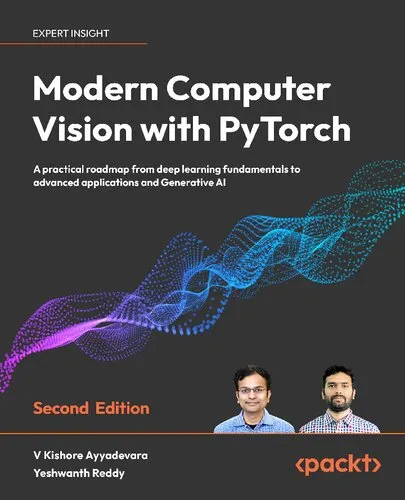
Modern Computer Vision with PyTorch: A Practical Roadmap From Deep Learning Fundamentals to Advanced Applications and Generative AI, 2nd Edition
V Kishore Ayyadevara,Yeshwanth Reddy
2023
View book