

Book guide and evaluation
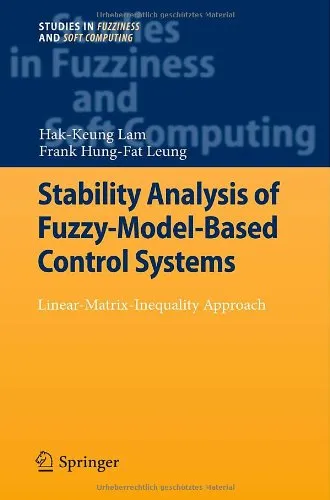
Stability Analysis of Fuzzy-Model-Based Control Systems: Linear-Matrix-Inequality Approach
Hak-Keung Lam,Frank Hung-Fat Leung (auth.)
English
Beginner
Software Engineering
4.9 / 5
0 reviews
2010
Published
246
pages
205
views
Introduction to Stability Analysis of Fuzzy-Model-Based Control Systems: Linear-Matrix-Inequality Approach Written by Hak-Keung Lam and Frank Hung-Fat Leung, this comprehensive book offers an in-depth exploration of stability analysis for fuzzy-model-based control systems
Before you read
What will you get from this book?
Introduction to Stability Analysis of Fuzzy-Model-Based Control Systems: Linear-Matrix-Inequality Approach
Written by Hak-Keung Lam and Frank Hung-Fat Leung, this comprehensive book offers an in-depth exploration of stability analysis for fuzzy-model-based control systems using the Linear Matrix Inequality (LMI) approach. It serves as a valuable resource for students, researchers, and professionals engaged in the fields of systems and control engineering, particularly those interested in fuzzy logic systems.
The book provides a structured and detailed guide to addressing stability issues in control systems modeled with fuzzy logic. Leveraging the strength of LMIs in tackling system stability problems, the authors unpack complex concepts in an accessible yet rigorous way. With a combination of theoretical insights, practical examples, and effective methodologies, this book is a pillar of knowledge in advancing modern control systems.
Detailed Summary of the Book
The foundation of this book lies in fuzzy logic and its application in control systems. Fuzzy-Model-Based (FMB) control systems provide a robust modeling mechanism for handling uncertainties and nonlinearities often present in real-world systems. While FMB systems present significant advantages, analyzing their stability is a challenging task, especially for complex dynamic processes. This book effectively bridges the gap by utilizing the Linear Matrix Inequality approach, a robust mathematical optimization tool.
The authors offer a systematic discussion on fuzzy rule-based systems and how they are transformed into Takagi-Sugeno (T-S) fuzzy models. These models are analyzed for stability conditions using LMI modeling, which simplifies complex stability problems into solvable convex optimization tasks. Several stability criteria applicable to nonlinear systems are discussed, providing readers with theoretical foundations and practical tools for diverse applications in engineering and beyond.
The book is structured to progress from fundamental concepts to more advanced topics. It covers stability criteria, robust control, observer design, as well as computational methods for solving LMIs effectively. By including numerical examples, case studies, and illustrative scenarios, the book helps readers apply the theoretical findings to real-world problems.
Key Takeaways
- Comprehensive exploration of fuzzy-model-based systems and their stability issues.
- Detailed explanation of Linear Matrix Inequalities and their applications in stability analysis.
- Step-by-step methodologies for stability analysis and controller design for nonlinear systems.
- Practical examples, mathematical rigor, and engineering perspectives to promote deeper understanding.
- Inclusive of advanced topics such as robust and observer-based control design.
Famous Quotes from the Book
"The elegance of fuzzy logic lies in its ability to emulate human thinking and decision-making processes, even in systems imbued with uncertainty and vagueness."
"Linear Matrix Inequalities form the backbone of modern optimization-based stability analysis - they provide both theoretical depth and practical reliability."
"In the context of control systems, stability analysis is not merely a mathematical exercise but a cornerstone of reliability and performance in engineering applications."
Why This Book Matters
With the growing demand for efficient control systems in modern technology, stability analysis has gained increased importance in a variety of fields, including robotics, aerospace, and industrial automation. This book is vital as it arms readers with the expertise needed to address complex problems in fuzzy systems and nonlinear dynamics.
The interdisciplinary approach of integrating fuzzy logic, control theory, and optimization creates a valuable repository of knowledge. By focusing on the Linear Matrix Inequality method, the book sets a clear, objective, and implementable path for solving stability problems in control systems. Moreover, its pedagogical approach makes it suitable for both academia and industry professionals.
In a field where precision and reliability are critical, this book helps bridge the gap between theoretical constructs and practical implementations. Whether you are an aspiring student, a seasoned researcher, or a practicing engineer, the insights gained from this book will enhance your understanding and application of fuzzy-model-based control systems.
Ask this book
Your question is answered in the context of this title and author. Each answer uses 2 points.
Sign in to ask the book assistant.
Reader reviews
0 reviews, 4.9 average out of 5
No reviews yet
If you have read this book, help the next reader with your experience.
Write a review
Sign in to publish a review.
Reader questions and answers
Ask a focused question and learn from the community.
Sign in to ask or answer a question.
No questions yet
Be the first to ask a clear, useful question.
What to read next
Related references that continue this learning path.



Modern Computer Vision with PyTorch: A Practical Roadmap From Deep Learning Fundamentals to Advanced Applications and Generative AI, 2nd Edition
V Kishore Ayyadevara,Yeshwanth Reddy
2023
View book